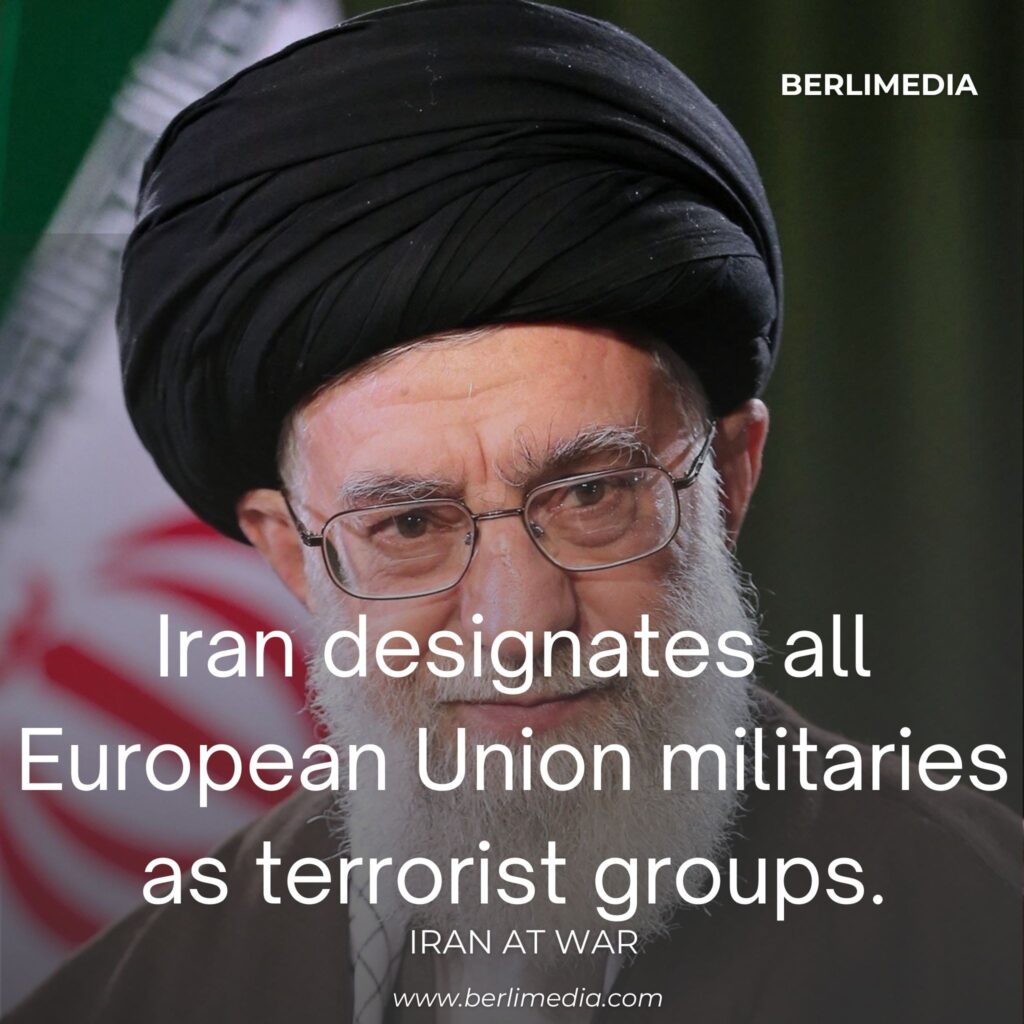
In an unprecedented diplomatic escalation, Iran has officially designated the militaries of all European Union member states as “terrorist groups.” The move, announced by Iranian Parliament Speaker Mohammad Bagher Ghalibaf, came in direct response to a recent decision by the European Union to label Iran’s Islamic Revolutionary Guard Corps (IRGC) as a terrorist organization.
This isn’t merely rhetorical posturing. Iran’s designation marks a bold intensification of tensions between Tehran and the EU, creating a new wrinkle in an already fraught geopolitical landscape.
Why This Happened: The IRGC Designation
Central to this escalation is the European Union’s decision in late January 2026 to add the Islamic Revolutionary Guard Corps (IRGC) — Iran’s elite military and paramilitary force — to its list of terrorist organizations.
The EU justified this extraordinary step as a political and moral response to Tehran’s violent crackdown on nationwide protests, where thousands of civilians were reportedly killed. EU leaders, including foreign policy chief Kaja Kallas, stated that “‘repression cannot go unanswered,” equating the IRGC with transnational terror organizations.
But Tehran saw it differently. Instead of acknowledging concerns over human rights abuses, Iran condemned the EU’s move as politically motivated and hostile, dismissing it as a violation of international norms.
Tehran’s Counter‑Move: EU Militaries on Terror Lists
Under a domestic legal mechanism known as Article 7 of Iran’s “Law on Countermeasures Against the Declaration of the IRGC as a Terrorist Organisation,” Iranian legislators automatically applied counter‑sanctions — including the terror designation — to European militaries.
In a dramatic parliamentary address, Ghalibaf even donned an IRGC uniform to signal solidarity with Iran’s most powerful military institution.
This measure is largely symbolic — Iran doesn’t plan to launch military action against EU states — but it significantly degrades diplomatic relations and complicates cooperation on security, trade, and regional stability.
What It Means for Global Politics
This tit‑for‑tat escalation has several real‑world implications:
🧨 1. Diplomatic Isolation Deepens
Iran’s response signals a hardening posture where reciprocal punitive steps become standard. Cooperation on issues like nuclear talks, prisoner releases, or sanctions relief is now far more difficult.
🌍 2. Europe’s Strategic Calculus Changes
EU countries now navigate a landscape where Tehran views even national defense forces as adversarial. That complicates NATO ties, trade negotiations, and energy diplomacy.
⚖️ 3. “Terrorist” Gets Weaponized Politically
Calling another state’s military a “terrorist group” typically carries severe legal consequences. Even if mostly symbolic here, the precedent weakens norms around terrorism designations and risks spiraling into broader political blame games.
🔥 4. Risk of Further Escalation
Iran has hinted at broader consequences if pressured further. The dispute could feed into existing tensions with the U.S., Middle Eastern allies, and other global powers.
Final Thoughts: A Dangerous Spiral
The standoff between Iran and the EU is more than a headline — it’s a symptom of a wider geopolitical fracture. By trading “terrorist” labels, both sides have moved away from diplomatic engagement and toward confrontation, albeit indirect.
If this continues, we could see real impacts on global security dialogues, economic sanctions, cross‑border cooperation, and public perception — far beyond the immediate dispute. And the worst‑case scenario isn’t conventional war; it’s a destabilized global order where labels replace dialogue and brinkmanship eclipses diplomacy.