
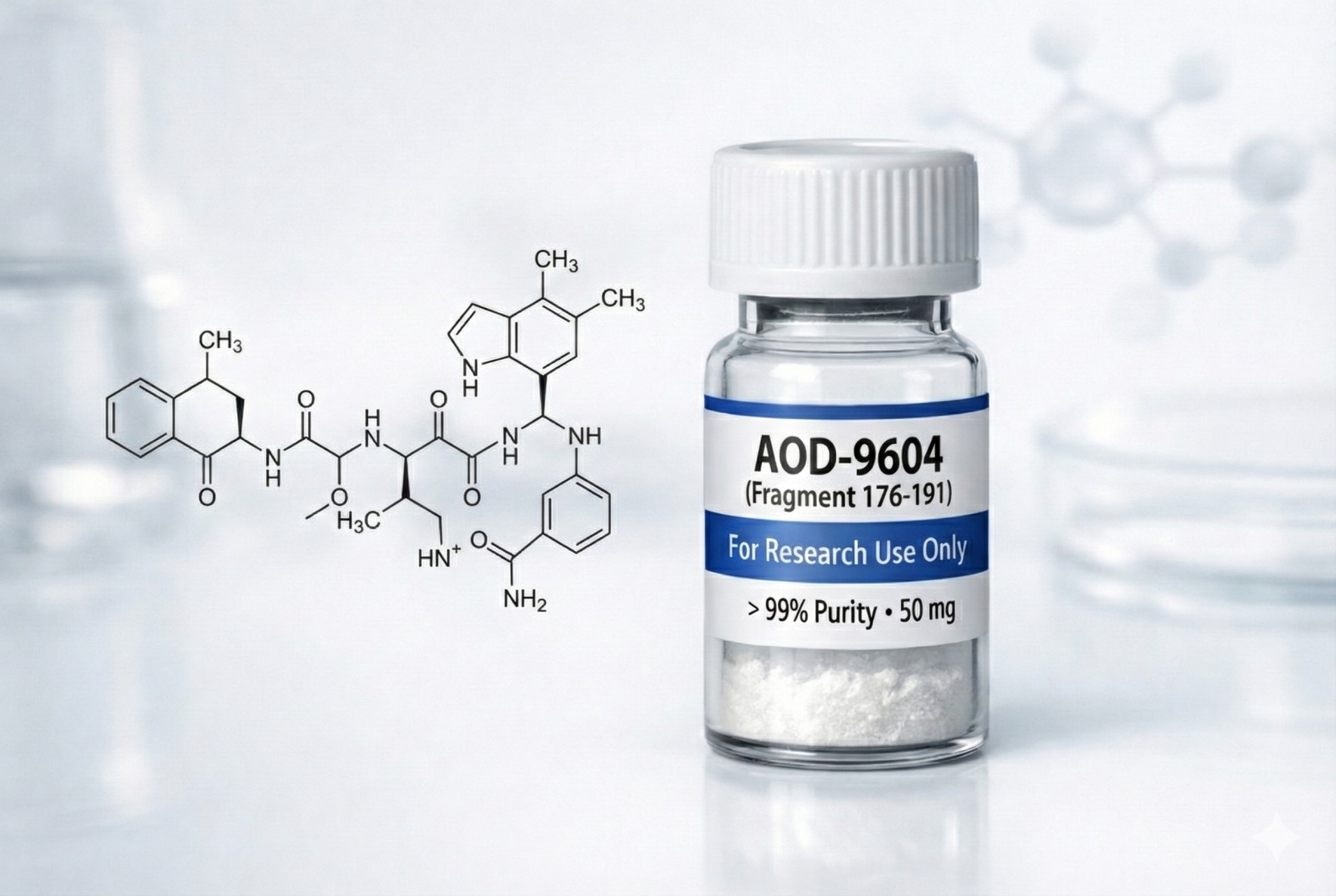
AOD-9604 (Tyr-hGH 177-191) is a synthetic 16-amino acid peptide fragment derived from the C-terminal region of human growth hormone (hGH), with an additional tyrosine residue at the N-terminus for enhanced stability.³ This peptide represents an innovative approach to metabolic dysfunction by targeting adipose tissue metabolism directly, without the adverse effects associated with full-length growth hormone therapy.¹
Unlike traditional hGH, which can cause insulin resistance, glucose intolerance, and elevated IGF-1 levels, AOD-9604 selectively stimulates lipolysis and inhibits lipogenesis in fat cells while maintaining normal glucose metabolism and insulin sensitivity.¹ ³ This selectivity makes AOD-9604 particularly valuable for research applications studying targeted fat metabolism without systemic growth hormone effects.
The peptide has undergone extensive preclinical and clinical evaluation, including six human clinical trials involving approximately 900 participants, demonstrating excellent safety and tolerability profiles indistinguishable from placebo.³
How It Works
Mechanism of Action
AOD-9604 functions through multiple interconnected pathways that specifically target adipose tissue metabolism:²
Beta-3 Adrenergic Receptor Modulation: Research demonstrates that AOD-9604 increases beta-3 adrenergic receptor (β3-AR) RNA expression in obese mice to levels comparable with lean mice.² This upregulation enhances lipolytic sensitivity and metabolic responsiveness. Importantly, while AOD-9604 increases β3-AR expression, studies using β3-AR knockout mice revealed the peptide can still increase energy expenditure and fat oxidation through alternative pathways.²
Direct Lipolytic Activity: The peptide directly stimulates hormone-sensitive lipase activity in adipocytes, promoting the breakdown of stored triglycerides into free fatty acids and glycerol.¹ ⁴ In vitro studies confirm AOD-9604 increases lipolytic activity in isolated adipose tissue from both obese rodents and humans.⁴
Anti-Lipogenic Effects: AOD-9604 inhibits acetyl-CoA carboxylase activity in hepatocytes and adipocytes, reducing the formation of new fat deposits.³ This dual action—increasing fat breakdown while preventing new fat storage—contributes to its metabolic benefits.
Selective Receptor Interaction: Ligand binding experiments demonstrate that AOD-9604 does not bind with high affinity to the hGH receptor and cannot induce receptor dimerization required for IGF-1 production.³ ⁵ This explains the absence of growth-promoting effects and the excellent safety profile observed in clinical trials.
Metabolic Effects
Studies in obese Zucker rats treated with 500 µg/kg/day AOD-9604 for 19 days showed over 50% reduction in body weight gain (15.8g vs. 35.6g in controls) without adverse effects on insulin sensitivity.¹ Euglycemic clamp techniques confirmed that chronic AOD-9604 treatment, unlike intact hGH, maintains normal insulin sensitivity.¹
In obese (ob/ob) mice, chronic treatment with AOD-9604 resulted in reduced body weight gain, increased fat oxidation rates, and enhanced lipolysis in adipose tissue.⁵ Importantly, these effects occurred without affecting glucose oxidation or plasma glucose levels, distinguishing AOD-9604 from hGH which depresses glucose oxidation and increases plasma glucose.³
Research Evidence
Primary Animal Studies
Study 1: Ng FM et al., 2000 – Metabolic studies of a synthetic lipolytic domain (AOD9604) of human growth hormone
Design: Obese Zucker rats received oral AOD9604 (500 µg/kg/day) for 19 days¹
Results:
- 50% reduction in body weight gain compared to controls
- Increased lipolytic activity in adipose tissue
- No adverse effects on insulin sensitivity (confirmed by euglycemic clamp)
- Maintained normal glucose metabolism
Significance: First demonstration that oral AOD9604 produces metabolic benefits without the diabetogenic effects of intact hGH¹
Study 2: Heffernan MA et al., 2000 – Effects of oral administration of a synthetic fragment of human growth hormone on lipid metabolism
Design: Multiple obesity models tested with oral AOD-9401 (early designation for AOD9604)⁴
Results:
- Reduced weight gain in obese rodent models
- Increased in vitro lipolytic activity in isolated adipose tissue
- Decreased lipogenic activity in adipose tissue
- Marked lipolytic and anti-lipogenic actions in human adipose tissue samples
Significance: Demonstrated AOD9604’s efficacy in human adipose tissue, supporting translation to clinical applications⁴
Study 3: Heffernan MA et al., 2001 – The Effects of Human GH and Its Lipolytic Fragment (AOD9604) on Lipid Metabolism Following Chronic Treatment in Obese Mice
Design: Obese (ob/ob) mice and β3-AR knockout mice treated chronically with AOD9604² ⁵
Results:
- Both hGH and AOD9604 reduced body weight and increased fat oxidation
- AOD9604 increased β3-AR RNA expression in obese mice to lean levels
- AOD9604 effects partially independent of β3-AR (demonstrated in knockout mice)
- No binding to hGH receptor or cell proliferation effects
- No effects on glucose metabolism (unlike hGH)
Significance: Confirmed novel mechanism of action independent of traditional hGH receptor pathways² ⁵
Human Clinical Trials
Comprehensive Safety Assessment: Stier H et al., 2013 – Safety and tolerability of the hexadecapeptide AOD9604 in humans
Design: Six randomized, double-blind, placebo-controlled trials involving 893 participants³
Key Studies:
- Phase I (METAOD001): IV doses 25-400 µg/kg in 15 healthy males
- Phase IIa (METAOD002): IV doses 25-100 µg/kg in 23 obese males (BMI ≥35)
- Phase IIa (METAOD003): Oral doses 9-54 mg in 17 obese males
- Phase IIa (METAOD004): Oral doses 9-54 mg daily for 7 days in 36 obese males
- Phase IIb (METAOD005): 12-week trial, 300 obese adults, doses 1-30 mg/day
- Phase IIb (METAOD006): 24-week trial, 502 obese adults, doses 0.25-1 mg/day
Results:
- Excellent safety profile indistinguishable from placebo across all doses and durations
- No significant adverse events attributed to AOD9604
- No changes in IGF-1 levels at any dose or duration
- No effects on glucose tolerance or insulin sensitivity
- No antibody formation detected in any participant
- Average weight loss of 2.6 kg vs. 0.8 kg placebo in 12-week study (1 mg/day dose)⁶ ⁷
- Improved glucose tolerance trends in subjects with impaired baseline glucose
Significance: Largest comprehensive safety dataset for any hGH fragment, demonstrating AOD9604 does not produce adverse effects associated with intact hGH³
Comprehensive Safety and Metabolism Study
Moré MI & Kenley D, 2014 – Safety and Metabolism of AOD9604, a Novel Nutraceutical Ingredient for Improved Metabolic Health
Design: Comprehensive non-clinical testing including genotoxicity, chronic toxicology, and pharmacokinetics⁸
Genotoxicity Studies:
- Ames test: No mutagenic activity up to 2,000 µg/plate
- CHO cell chromosome aberration assay: No clastogenic activity
- Bone marrow micronucleus assay: No evidence of chromosomal damage
Chronic Toxicology:
- 6-month rat study: No toxicological concerns at doses up to 100 mg/kg/day
- 9-month cynomolgus monkey study: No adverse effects at doses up to 50 mg/kg/day
- Trend toward reduced body weight gain in females (consistent with intended metabolic activity)
Pharmacokinetics:
- Rapid absorption after oral administration (~40% bioavailability in rats)
- Very short plasma half-life (~3 minutes IV in pigs)
- Degradation via sequential N-terminal amino acid removal
- Principal metabolites (-2aa and -3aa) retain some lipolytic activity
- Tissue distribution: pancreas, pineal body, thyroid, liver, kidney cortex
- No CNS penetration
Significance: Comprehensive pre-clinical safety package supporting GRAS (Generally Recognized As Safe) status determination⁸
Current Status & Considerations
Research Status
As of January 2026, AOD-9604 has completed multiple Phase IIb clinical trials but is not FDA-approved for any medical indication.³ The peptide has received GRAS status for intended use in foods, drinks, and dietary supplements, conditional on safety data publication.³ All human efficacy and safety data come from completed clinical trials in Australia involving approximately 900 participants.³
Potential Research Applications
Obesity and Metabolic Syndrome: Clinical trials demonstrated modest but statistically significant weight loss (average 2.6 kg over 12 weeks at 1 mg/day dose) with preferential reduction in abdominal adipose tissue.⁶ ⁷ The metabolic mechanism—targeting fat oxidation rather than appetite suppression—represents a novel approach distinct from current obesity medications.⁹
Insulin Sensitivity Research: Unlike hGH which induces insulin resistance, AOD-9604 maintains or potentially improves glucose tolerance.¹ ³ Research applications may include studying metabolic interventions that preserve insulin sensitivity while promoting fat loss.
Cartilage and Joint Research: Emerging preclinical data suggests potential applications in cartilage repair and osteoarthritis research, though human clinical data remains limited.¹⁰
Age-Related Metabolic Decline: Since hGH secretion declines with age and obesity, AOD-9604 may offer research utility for studying age-associated metabolic dysfunction without growth hormone side effects.³
Safety Profile Summary
Across all clinical trials totaling approximately 900 participants and durations up to 24 weeks:³
- No drug-related serious adverse events
- No treatment-related study withdrawals
- No effects on IGF-1 levels (eliminating cancer risk concerns associated with hGH)
- No glucose intolerance or insulin resistance (unlike hGH)
- No antibody formation (no immunogenicity concerns)
- Adverse event profile indistinguishable from placebo
The peptide demonstrated excellent tolerability across dose ranges from 0.25 mg to 54 mg daily via both IV and oral routes.³
Important Considerations
Not FDA-Approved: AOD-9604 is not approved for any medical use and remains classified as a research chemical for laboratory applications.³
Pharmacokinetic Limitations: The very short plasma half-life (~3 minutes) requires consideration for research protocol design, though oral administration provides sustained absorption.⁸
Efficacy Variability: While statistically significant weight loss occurred in controlled trials, effects were modest and individual responses varied.⁷ ⁹ Later trials incorporating intensive diet and exercise regimens showed reduced differential effects compared to placebo.³
Footnotes
- Ng FM, Sun J, Sharma L, et al. Metabolic studies of a synthetic lipolytic domain (AOD9604) of human growth hormone. International Journal of Obesity. 2000;24(12):1586-1593.
- Heffernan MA, Thorburn AW, Fam B, et al. Effects of human GH and its lipolytic fragment (AOD9604) on lipid metabolism following chronic treatment in obese mice. Endocrinology. 2001;142(12):5182-5189.
- Stier H, Vos E, Kenley D. Safety and tolerability of the hexadecapeptide AOD9604 in humans. Journal of Endocrinology and Metabolism. 2013;3(1-2):7-15.
- Heffernan MA, Jiang WJ, Thorburn AW, et al. Effects of oral administration of a synthetic fragment of human growth hormone on lipid metabolism. Endocrinology. 2000;141(9):3239-3246.
- Heffernan MA, Thorburn AW, Fam B, et al. Increase of fat oxidation and weight loss in obese mice caused by chronic treatment with human growth hormone or a modified C-terminal fragment. International Journal of Obesity. 2001;25(10):1442-1449.
- Ng FM, Bornstein J, Pullin C, et al. Obesity Pharmacotherapy: Current Perspectives and Future Directions. Clinical Obesity. 2012;2(5-6):155-166.
- Phase IIb clinical trial (METAOD005). Metabolic Pharmaceuticals Ltd. Randomized, double-blind, placebo-controlled 12-week efficacy study in 300 obese adults. 2004.
- Moré MI, Kenley D. Safety and metabolism of AOD9604, a novel nutraceutical ingredient for improved metabolic health. Journal of Endocrinology and Metabolism. 2014;4(3):64-77.
- Metabolic Pharmaceuticals Ltd. Phase IIb clinical trial update. First 100 subjects complete trial of AOD9604. BioSpace. 2006.
- AOD-9604 Peptide: Weight Support & Joint Health research overview. Paragon Sports Medicine. 2006.
References
Primary Research Studies
Ng FM, Sun J, Sharma L, Libinaka R, Jiang WJ, Gianello R. Metabolic studies of a synthetic lipolytic domain (AOD9604) of human growth hormone. International Journal of Obesity and Related Metabolic Disorders. 2000;24(12):1586-1593. PMID: 11146367.
Heffernan MA, Jiang WJ, Thorburn AW, et al. Effects of oral administration of a synthetic fragment of human growth hormone on lipid metabolism. Endocrinology. 2000;141(9):3239-3246. PMID: 10950816.
Heffernan MA, Thorburn AW, Fam B, et al. Effects of human GH and its lipolytic fragment (AOD9604) on lipid metabolism and fat distribution in the mouse. Endocrinology. 2001;142(12):5182-5189. PMID: 11713213.
Comprehensive Safety Studies
Stier H, Vos E, Kenley D. Safety and tolerability of the hexadecapeptide AOD9604 in humans. Journal of Endocrinology and Metabolism. 2013;3(1-2):7-15. doi:10.4021/jem157w.
Moré MI, Kenley D. Safety and metabolism of AOD9604, a novel nutraceutical ingredient for improved metabolic health. Journal of Endocrinology and Metabolism. 2014;4(3):64-77. doi:10.14740/jem213w.
Additional Clinical References
Phase IIb Efficacy Trial. Randomized, double-blind, placebo-controlled study assessing 12-week treatment with AOD9604 in 300 obese adults. Metabolic Pharmaceuticals Ltd. 2004.
Disclaimer
This content is for educational and research purposes only and does not constitute medical advice. AOD-9604 is not FDA-approved for human use. All products are intended strictly for laboratory research and development purposes only.