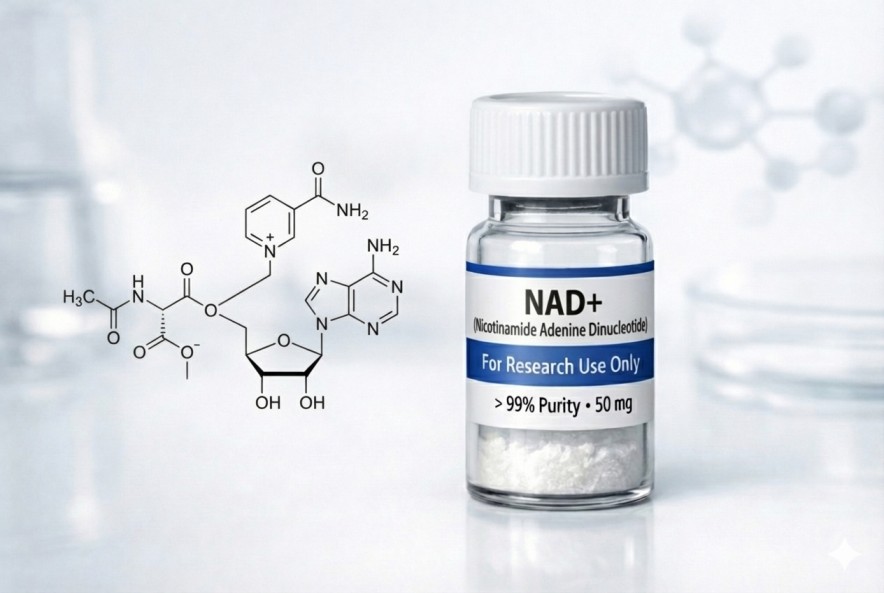
Nicotinamide adenine dinucleotide (NAD+) is a dinucleotide composed of two nucleotides joined through their phosphate groups, with one nucleotide containing an adenine nucleobase and the other containing nicotinamide.² This small molecule serves as one of the most abundant and versatile cofactors in human biology, participating in fundamental processes ranging from glycolysis and the citric acid cycle to oxidative phosphorylation and cellular stress responses.² ³
NAD+ exists in two interconvertible forms: the oxidized NAD+ and reduced NADH.³ This redox couple enables NAD+ to function as an electron carrier in metabolic reactions, accepting electrons (becoming NADH) and donating electrons (regenerating NAD+) to drive ATP production in mitochondria.³ Beyond its redox functions, NAD+ serves as a consumed substrate for three major enzyme families:² ³
Sirtuins (SIRT1-7): NAD+-dependent deacylases that regulate metabolic homeostasis, mitochondrial biogenesis, DNA repair, inflammation, and circadian rhythms by removing acetyl groups from target proteins.² ³ These enzymes consume NAD+ to produce nicotinamide (NAM), O-acetyl-ADP-ribose, and the deacylated protein product.²
Poly(ADP-ribose) polymerases (PARPs): Nuclear enzymes activated by DNA damage that consume NAD+ to generate poly(ADP-ribose) polymers for DNA repair, chromatin modification, and cell death pathways.² ³ PARP activation can rapidly deplete cellular NAD+ under conditions of severe genotoxic stress.³
CD38/CD157: Ectoenzymes and NADases that hydrolyze NAD+ to produce cyclic ADP-ribose (cADPR) and NAADP, second messengers regulating calcium signaling, immune function, and inflammation.² ³ CD38 is recognized as a primary driver of age-related NAD+ decline, with expression increasing substantially in aged tissues.³ ⁴
The discovery that NAD+ levels decline progressively with age—by 30-50% in multiple tissues including brain, liver, skeletal muscle, adipose tissue, and skin—has positioned NAD+ metabolism as a central regulator of aging and age-related disease.² ⁴ This decline results from both increased NAD+ consumption (particularly by CD38 and PARPs) and decreased biosynthesis through the rate-limiting enzyme nicotinamide phosphoribosyltransferase (NAMPT).² ³
How It Works
Mechanism of Action
NAD+ supplementation, typically achieved through precursor administration, works through multiple interconnected mechanisms:² ³
Energy Metabolism and Mitochondrial Function: NAD+ is essential for all stages of cellular respiration, from glycolysis through the electron transport chain.³ In glycolysis, NAD+ accepts electrons from glucose-derived intermediates, becoming NADH. This NADH then delivers electrons to Complex I of the mitochondrial electron transport chain, driving ATP synthesis through oxidative phosphorylation.³ The NAD+/NADH ratio serves as a critical sensor of cellular energy status, with high ratios indicating oxidative metabolism and low ratios suggesting reductive stress or metabolic dysfunction.³
Sirtuin Activation: The sirtuin family of NAD+-dependent deacylases regulates numerous metabolic and stress-response pathways.² ³ SIRT1, the most extensively studied isoform, deacetylates transcription factors and cofactors including PGC-1α (promoting mitochondrial biogenesis), FOXO proteins (regulating stress resistance), and p53 (modulating cell survival).² ³ By increasing NAD+ availability, precursor supplementation may enhance sirtuin activity, mimicking aspects of caloric restriction.³
DNA Repair and Genomic Stability: PARPs utilize NAD+ to generate poly(ADP-ribose) chains at sites of DNA damage, recruiting repair machinery and facilitating DNA repair.² ³ NAD+ precursor supplementation replenishes NAD+ pools, supporting efficient DNA repair while preventing PARP-mediated NAD+ depletion.²
Precursor-Specific Pathways
Different NAD+ precursors utilize distinct biosynthetic pathways:²
Nicotinamide Mononucleotide (NMN): Directly converted to NAD+ by NMNAT enzymes, potentially bypassing the rate-limiting NAMPT step.² Recent evidence suggests NMN may require dephosphorylation to NR for cellular uptake in some tissues.¹
Nicotinamide Riboside (NR): Phosphorylated by NR kinases (NRK1/2) to form NMN, then converted to NAD+ by NMNAT enzymes.² Does not cause flushing and is generally well-tolerated.
Nicotinamide (NAM): Converted to NMN by NAMPT (rate-limiting), then to NAD+.² At high doses, NAM can inhibit sirtuins through product inhibition.³
Nicotinic Acid (NA/Niacin): Converted to NAD+ via Preiss-Handler pathway.² Causes flushing through GPR109A receptor activation, limiting tolerability.²
Research Evidence
Comprehensive Meta-Analysis
Jiang Z et al., 2024 – Efficacy of oral nicotinamide mononucleotide supplementation on glucose and lipid metabolism for adults: a systematic review with meta-analysis on randomized controlled trials
Design: Systematic review and meta-analysis following PRISMA 2020 guidelines, registered in PROSPERO (CRD42023482534). Included 12 randomized controlled trials (RCTs) with 513 total participants examining oral NMN supplementation effects on glucose and lipid metabolism.¹
Methodology:
- Comprehensive database search: PubMed, Embase, Web of Science, Cochrane Library (through March 2024)
- Inclusion criteria: RCTs investigating oral NMN supplementation in adults (≥18 years)
- Risk of bias assessment using Cochrane RoB2 tool
- Random-effects meta-analysis with standardized mean differences (SMD) and mean differences (MD)
- Publication bias evaluation using funnel plots and Egger’s test
- Subgroup analyses by age, BMI, dose, and duration
Quality Assessment:
- 7 studies rated as “some concerns” for bias risk
- 5 studies rated as “high risk of bias”
- Publication bias detected for triglycerides (Egger’s test p=0.028)
- Overall quality limitations noted across the evidence base
Primary Outcomes – Glucose Metabolism:
- Fasting glucose: No significant effect (SMD -0.10, 95% CI: -0.41 to 0.20, p=0.51)¹
- Insulin: No significant effect (SMD -0.18, 95% CI: -0.45 to 0.09, p=0.20)¹
- HOMA-IR: No significant effect (SMD -0.21, 95% CI: -0.49 to 0.07, p=0.14)¹
- HbA1c: No significant effect (SMD -0.37, 95% CI: -1.06 to 0.32, p=0.29)¹
Primary Outcomes – Lipid Metabolism:
- Total cholesterol: No significant effect (MD -2.90 mg/dL, 95% CI: -7.82 to 2.03, p=0.25)¹
- Triglycerides (overall): No significant effect (MD -15.69 mg/dL, 95% CI: -33.81 to 2.43, p=0.09)¹
- Triglycerides (overweight/obese subgroup): Significant reduction (MD -27.80 mg/dL, 95% CI: -42.61 to -13.00, p<0.001)¹
- LDL cholesterol: No significant effect (MD -1.46 mg/dL, 95% CI: -5.68 to 2.77, p=0.50)¹
- HDL cholesterol: No significant effect (MD 0.06 mg/dL, 95% CI: -1.46 to 1.59, p=0.93)¹
Secondary Outcomes:
- Blood NAD+ levels: Significant increase (SMD 1.79, 95% CI: 0.84 to 2.73, p<0.001)¹
- Body weight: No significant effect (MD -0.49 kg, 95% CI: -1.57 to 0.60, p=0.38)¹
- BMI: No significant effect (MD -0.35 kg/m², 95% CI: -0.80 to 0.10, p=0.13)¹
- Physical performance: No significant improvement in walking distance or muscle strength¹
Subgroup Analyses:
- Age (<60 vs. ≥60 years): No significant differences in metabolic outcomes
- BMI (overweight/obese vs. normal weight): Triglyceride reduction only in overweight/obese subgroup
- Dose (<500 mg vs. ≥500 mg): No dose-dependent differences
- Duration (<12 weeks vs. ≥12 weeks): No duration-dependent differences
Critical Conclusion: “Our findings suggest that an exaggeration of the benefits of NMN supplementation may exist in the field. While NMN supplementation effectively increases blood NAD+ concentrations, this does not consistently translate into improved glucose or lipid metabolism markers in most populations.”¹
Significance: This is the most comprehensive and methodologically rigorous meta-analysis of NMN supplementation to date, providing critical perspective on the disconnect between NAD+ bioavailability enhancement and clinical metabolic outcomes. The findings highlight publication bias, study quality concerns, and the need for larger, longer-duration trials with clinically relevant endpoints.¹
Key Individual Studies Included in Meta-Analysis
Yoshino J et al., 2021 – Prediabetic Women Study
Included in Jiang meta-analysis: Yes¹
Design: Randomized, placebo-controlled, double-blind trial in 25 postmenopausal women with prediabetes, BMI ≥25 kg/m². Participants received NMN 250 mg/day or placebo for 10 weeks.⁵
Key Finding: NMN increased insulin-stimulated glucose disposal by 25% measured by hyperinsulinemic-euglycemic clamp (gold standard method).⁵
Meta-Analysis Context: This positive finding represents one study among 12 analyzed. When pooled with other trials, the overall effect on glucose metabolism was not statistically significant, highlighting the importance of not generalizing single-study results.¹
Igarashi M et al., 2022 – Healthy Adults Study
Included in Jiang meta-analysis: Yes¹
Design: Randomized, double-blind, placebo-controlled trial in 108 healthy Japanese adults aged 20-65 years receiving NMN 125 mg, 250 mg, or placebo for 12 weeks.⁶
Results:
- Significant increases in blood NAD+ levels in both NMN groups
- No significant changes in glucose metabolism markers
- No significant changes in body composition
- Improved drowsiness scores in 250 mg group
Meta-Analysis Context: Largest single trial in the meta-analysis, contributing substantially to the conclusion that NAD+ elevation does not consistently produce metabolic improvements in healthy populations.¹
Liao B et al., 2021 – Exercise Performance Study
Included in Jiang meta-analysis: Yes¹
Design: Randomized trial in 48 recreationally trained runners receiving NMN 300 mg, 600 mg, 1200 mg, or placebo for 6 weeks with aerobic training.⁷
Results:
- Dose-dependent increases in blood NAD+ levels
- Improved aerobic capacity at 1200 mg dose (VO2max increased 5%)
- No significant effects on muscle strength or body composition
Meta-Analysis Context: One of few trials showing functional benefits, though effects were modest and dose-dependent. When combined with other exercise studies showing no benefit, overall meta-analytic effect on physical performance was non-significant.¹
Studies NOT Included But Relevant to NAD+ Precursors
Martens CR et al., 2018 – Nicotinamide Riboside (NR) Cardiovascular Study
Note: This studied NR, not NMN, so was not included in Jiang et al. meta-analysis.¹
Design: Randomized, double-blind, placebo-controlled crossover trial in 24 healthy adults aged 55-79 years receiving NR 500 mg twice daily for 6 weeks.⁸
Results:
- NR increased whole blood NAD+ by 60%
- Systolic blood pressure decreased ~10 mmHg in hypertensive subset
- Reduced arterial stiffness trends
- Reduced inflammatory markers
Relevance: Demonstrates that different NAD+ precursors may have distinct efficacy profiles, with NR showing cardiovascular benefits not consistently observed with NMN.⁸

Current Status & Considerations
Research Status
As of January 2026, no NAD+ precursor is FDA-approved for any age-related indication.⁴ The most comprehensive meta-analysis to date (Jiang et al., 2024) concludes that while NMN supplementation effectively increases blood NAD+ levels, benefits may be exaggerated in published literature, with limited translation to metabolic outcomes in most populations.¹
The field faces significant challenges including publication bias (detected for triglycerides, p=0.028), study quality concerns (58% of trials had “some concerns” or “high risk” of bias), and small sample sizes limiting generalizability.¹
Potential Research Applications
Metabolic Disorders – With Caveats: Despite the limited meta-analytic evidence, NMN may benefit specific subpopulations including prediabetic individuals and those with obesity.¹ ⁵ The Jiang meta-analysis found significant triglyceride reduction only in overweight/obese participants (MD -27.80 mg/dL), suggesting body composition influences response.¹
Research priorities include identifying responders vs. non-responders through biomarkers, genetic polymorphisms in NAD+ metabolism enzymes, and baseline NAD+ status.¹
Cardiovascular Health: NR (not NMN) shows promise for blood pressure reduction and arterial function in hypertensive older adults.⁸ Research applications include comparing precursor efficacy and investigating combination therapies with standard cardiovascular medications.
Physical Performance: The Jiang meta-analysis found no significant overall effect on physical performance, though one high-dose study (1200 mg) showed modest aerobic capacity improvements.¹ ⁷ Research should focus on dose optimization, timing relative to exercise, and populations with documented NAD+ deficiency.
Aging Research: While preclinical models consistently demonstrate anti-aging effects, human translation remains disappointing based on current RCT evidence.¹ Longer-duration studies (>6 months) with aging-specific functional endpoints are critically needed.
Safety Profile Summary
Across trials analyzed in the Jiang meta-analysis (513 participants, doses 125-1200 mg/day, durations 4-24 weeks):¹
- Well-tolerated with no serious adverse events reported
- Mild gastrointestinal symptoms in some participants
- No significant changes in liver or kidney function markers
- No consistent adverse effects on glucose control
However, long-term safety beyond 24 weeks remains unstudied in controlled trials.¹
Important Considerations
Evidence Quality Concerns: The Jiang meta-analysis identified substantial methodological limitations: 58% of trials had quality concerns, publication bias was detected, and heterogeneity was high for several outcomes.¹ This suggests current evidence may overestimate benefits.
Bioavailability Does Not Equal Clinical Benefit: The consistent finding across studies is that NMN reliably increases blood NAD+ (SMD 1.79, p<0.001) but fails to produce corresponding metabolic improvements in most outcomes.¹ This disconnect requires mechanistic investigation—possible explanations include inadequate tissue penetration, insufficient dosing, wrong target populations, or flawed assumptions about NAD+ as a therapeutic target.
Individual Variability: Response to NAD+ precursor supplementation appears highly variable, likely influenced by baseline NAD+ status, age, metabolic health, genetic polymorphisms, and gut microbiota composition.¹ ⁴ Current trials lack biomarkers to identify who will benefit.
Precursor Selection: Different precursors (NMN, NR, NAM, NA) utilize distinct biosynthetic pathways with varying efficiency and tissue distribution.² Direct comparative trials are lacking, preventing evidence-based precursor selection.¹
Publication Bias: The Jiang meta-analysis detected publication bias for triglycerides (p=0.028), suggesting negative studies may be underrepresented in the literature.¹ This is particularly concerning in a field driven by commercial interests in supplement sales.
Duration and Dose Gaps: Most trials are short-duration (median 12 weeks) with modest doses (median 300 mg/day).¹ Whether longer treatment or higher doses would yield different results remains unknown, though subgroup analyses found no duration or dose-response effects in current evidence.¹
Footnotes
- Jiang Z, Pan E, Wang S, et al. Efficacy of oral nicotinamide mononucleotide supplementation on glucose and lipid metabolism for adults: a systematic review with meta-analysis on randomized controlled trials. Critical Reviews in Food Science and Nutrition. 2024. doi:10.1080/10408398.2024.2387324.
- Zapata-Pérez R, Wanders D, Navas-Enamorado C, et al. NAD+ metabolism: pathophysiologic mechanisms and therapeutic potential. Signal Transduction and Targeted Therapy. 2020;5:231.
- Verdin E. NAD+ in aging, metabolism, and neurodegeneration. Science. 2015;350(6265):1208-1213.
- Strømgaard K, Sedej S, Talbot K, et al. Clinical evidence for the use of NAD+ precursors to slow aging. Geromedicine. 2025;1:e0008.
- Yoshino J, Baur JA, Imai SI. Nicotinamide mononucleotide increases muscle insulin sensitivity in prediabetic women who are overweight or obese. Science. 2021;372(6547):1224-1229.
- Igarashi M, Nakagawa-Nagahama Y, Miura M, et al. Chronic nicotinamide mononucleotide supplementation elevates blood nicotinamide adenine dinucleotide levels and alters muscle function in healthy older men. NPJ Aging. 2022;8:5.
- Liao B, Zhao Y, Wang DW, Zhang X, Hao X, Hu M. Nicotinamide mononucleotide supplementation enhances aerobic capacity in amateur runners: a randomized, double-blind study. Journal of the International Society of Sports Nutrition. 2021;18(1):54.
- Martens CR, Denman BA, Mazzo MR, et al. Chronic nicotinamide riboside supplementation is well-tolerated and elevates NAD+ in healthy middle-aged and older adults. Nature Communications. 2018;9:1286.
References
Systematic Review and Meta-Analysis
Jiang Z, Pan E, Wang S, Li J, Wu Q, Zhao G. Efficacy of oral nicotinamide mononucleotide supplementation on glucose and lipid metabolism for adults: a systematic review with meta-analysis on randomized controlled trials. Critical Reviews in Food Science and Nutrition. 2024. doi:10.1080/10408398.2024.2387324. PMID: 39116016.
Key Individual RCTs (Included in Meta-Analysis)
Yoshino J, Baur JA, Imai SI. Nicotinamide mononucleotide increases muscle insulin sensitivity in prediabetic women who are overweight or obese. Science. 2021;372(6547):1224-1229. doi:10.1126/science.abe9985. PMID: 33888596.
Igarashi M, Nakagawa-Nagahama Y, Miura M, et al. Chronic nicotinamide mononucleotide supplementation elevates blood nicotinamide adenine dinucleotide levels and alters muscle function in healthy older men. NPJ Aging. 2022;8:5. doi:10.1038/s41514-022-00084-z.
Liao B, Zhao Y, Wang DW, Zhang X, Hao X, Hu M. Nicotinamide mononucleotide supplementation enhances aerobic capacity in amateur runners: a randomized, double-blind study. Journal of the International Society of Sports Nutrition. 2021;18(1):54. doi:10.1186/s12970-021-00442-4.
Additional Key Studies (Different NAD+ Precursors)
Martens CR, Denman BA, Mazzo MR, et al. Chronic nicotinamide riboside supplementation is well-tolerated and elevates NAD+ in healthy middle-aged and older adults. Nature Communications. 2018;9:1286. doi:10.1038/s41467-018-03421-7. PMID: 29599478.
Comprehensive Reviews
Zapata-Pérez R, Wanders D, Navas-Enamorado C, et al. NAD+ metabolism: pathophysiologic mechanisms and therapeutic potential. Signal Transduction and Targeted Therapy. 2020;5:231. doi:10.1038/s41392-020-00311-7. PMID: 33024088.
Strømgaard K, Sedej S, Talbot K, et al. Clinical evidence for the use of NAD+ precursors to slow aging. Geromedicine. 2025;1:e0008.
Verdin E. NAD+ in aging, metabolism, and neurodegeneration. Science. 2015;350(6265):1208-1213. doi:10.1126/science.aac4854.
Disclaimer
This content is for educational and research purposes only and does not constitute medical advice. NAD+ precursors are not FDA-approved for age-related or metabolic conditions. Current meta-analytic evidence suggests benefits may be exaggerated in published literature. All products are intended strictly for laboratory research and development purposes only.