 Ipamorelin
$195.00

Review article author: University of Maryland Center of Excellence in Regulatory Science and Innovation (M-CERSI) (2020)
Primary clinical study: Beck DE et al. (2014)
Foundational study: Raun K et al. (1998)
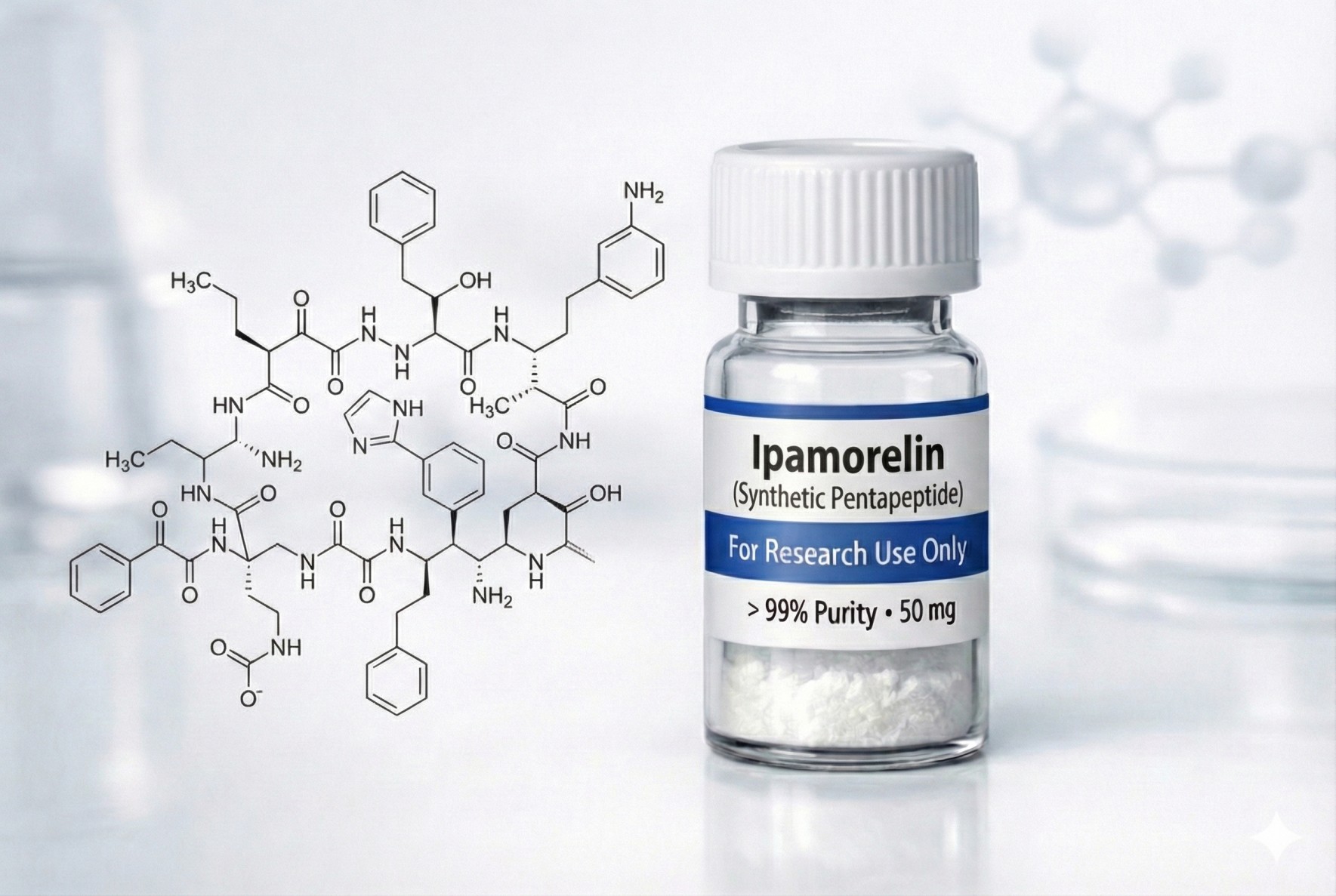
Ipamorelin is a synthetic pentapeptide (Aib-His-D-2-Nal-D-Phe-Lys-NH₂) that functions as a selective growth hormone secretagogue, stimulating GH release through the ghrelin receptor (GHS-R1a) pathway.¹ ² ³ Distinguished from other growth hormone-releasing peptides by its unique selectivity profile, ipamorelin stimulates GH secretion with potency comparable to GHRP-6 but without significantly affecting ACTH, cortisol, prolactin, or other pituitary hormones—even at doses 200-fold higher than the effective dose for GH release.² This selective GH stimulation without unwanted hormonal side effects positions ipamorelin as theoretically superior to earlier GHRPs. However, a comprehensive 2020 systematic review conducted for the FDA identified only one human clinical trial examining ipamorelin—a 2014 Phase 2 study in postoperative ileus that found the compound well-tolerated but without significant efficacy for the tested indication.¹ ⁴ As of 2026, ipamorelin remains FDA-unapproved for any medical indication, with clinical evidence limited to a single small trial and extensive preclinical data that has not translated to human therapeutic applications.¹ ³
$195.00
Ipamorelin is a pentapeptide growth hormone secretagogue developed through systematic medicinal chemistry optimization of the GHRP-1 scaffold, specifically by removing the central Ala-Trp dipeptide while maintaining GH-releasing potency and efficacy.² The compound was designed to address limitations of earlier GHRPs (GHRP-2, GHRP-6, hexarelin) which, while effective at stimulating GH release, also elevated ACTH, cortisol, and prolactin—potentially limiting therapeutic utility and causing unwanted side effects.²
The structural modifications in ipamorelin result in a compound that displays high GH-releasing potency (EC₅₀ = 1.3±0.4 nmol/L in vitro) comparable to GHRP-6, but with dramatically improved selectivity.² ³ Pharmacological profiling using GHRP and GHRH antagonists confirmed that ipamorelin stimulates GH release via the GHRP-like receptor (now known as the ghrelin receptor or GHS-R1a), not through the GHRH receptor pathway.²
The hallmark feature distinguishing ipamorelin from other GHRPs is its selectivity for GH release without affecting other pituitary hormones.² In swine studies, while both GHRP-6 and GHRP-2 significantly increased plasma ACTH and cortisol levels, ipamorelin did not release ACTH or cortisol at levels different from GHRH stimulation—even at doses more than 200-fold higher than the ED₅₀ for GH release.² Similarly, ipamorelin, GHRP-6, and GHRH all failed to affect FSH, LH, prolactin, or TSH plasma levels.² This unique selectivity profile suggested ipamorelin might offer the benefits of GH stimulation without the adverse effects associated with elevated stress hormones.²
Pharmacokinetic studies in humans revealed a terminal elimination half-life of approximately 2 hours following IV administration, with a brief GH release window consistent with this short half-life.⁵ Unlike modified GHRH analogs with extended durations (CJC-1295 with DAC), ipamorelin requires multiple daily administrations to maintain elevated GH secretory capacity.⁵
Despite promising preclinical characterization and theoretical advantages, clinical development of ipamorelin has been extremely limited. A comprehensive 2020 systematic review conducted by the University of Maryland for the FDA—searching all major databases through November 2019—identified only one human clinical trial meeting inclusion criteria.¹ This single trial (Beck et al., 2014) examined ipamorelin for postoperative ileus rather than GH deficiency or body composition applications, finding the compound well-tolerated but without significant efficacy for the tested indication.¹ ⁴
Mechanism of Action
Ipamorelin operates through the ghrelin receptor (GHS-R1a) signaling pathway to stimulate pituitary GH release:² ³
Ghrelin Receptor Activation: Ipamorelin binds to and activates GHS-R1a receptors expressed on somatotroph cells in the anterior pituitary.² ³ GHS-R1a is a G-protein coupled receptor that, upon ligand binding, activates Gq proteins leading to phospholipase C (PLC) activation, inositol trisphosphate (IP₃) production, and intracellular calcium mobilization.³ The calcium flux triggers immediate GH secretion from stored granules while also activating protein kinase C (PKC) and other signaling cascades that enhance GH gene transcription.³
Selective GH Release: The defining characteristic of ipamorelin is its remarkable selectivity for GH secretion without affecting other pituitary hormones.² In preclinical studies across multiple species (rats, swine), ipamorelin released GH with potency and efficacy comparable to GHRP-6:²
Unlike GHRP-6 and GHRP-2, which significantly elevated ACTH and cortisol (stress hormones) in swine at doses 45-85-fold higher than the ED₅₀ for GH release, ipamorelin showed no effect on ACTH or cortisol even at doses exceeding 200-fold the GH-releasing ED₅₀.² This suggests ipamorelin does not activate hypothalamic neurons regulating the stress axis, avoiding a major limitation of earlier GHRPs.²
Complementary Mechanism with GHRH: While ipamorelin acts through the ghrelin receptor (GHS-R) pathway, GHRH analogs act through the GHRH receptor (GHRH-R) pathway.² ³ These pathways are complementary rather than redundant—GHRH primarily enhances GH pulse amplitude and stimulates GH synthesis, while GHRPs like ipamorelin suppress somatostatin inhibition and enhance pulse frequency.³ When coadministered, GHRH analogs and GHRPs produce synergistic GH release substantially exceeding either compound alone.³ This synergy explains the popularity of ipamorelin + CJC-1295 combination protocols in clinical practice, though no human trials have systematically validated this combination.¹ ³
Pharmacokinetics: Following intravenous administration in humans, ipamorelin displays a terminal elimination half-life of approximately 2 hours with rapid distribution and clearance.⁵ Peak GH responses occur 30-60 minutes post-administration, returning toward baseline within 3-4 hours.⁵ This short duration necessitates 2-3 daily administrations if sustained GH elevation is desired, typically timed before meals or exercise to maximize physiological synergy with endogenous GH pulses.³ ⁵
Gastrointestinal Prokinetic Effects: Beyond GH stimulation, ghrelin receptor agonism produces gastrointestinal prokinetic effects—enhancing gastric emptying and intestinal transit through direct effects on enteric neurons and smooth muscle.⁴ ⁶ This dual mechanism (GH release + GI motility) led to clinical investigation of ipamorelin for postoperative ileus, a temporary impairment of GI motility following abdominal surgery.¹ ⁴ However, the 2014 Beck trial found no significant benefit for this indication despite acceptable safety.¹ ⁴
Physiological Effects
The downstream effects of GH elevation include:² ³
Comprehensive Systematic Review
University of Maryland Center of Excellence in Regulatory Science and Innovation (M-CERSI), 2020 – Ipamorelin acetate: Summary Report for FDA 503B Bulks List Evaluation
*Comprehensive scoping review examining clinical use of ipamorelin to assist FDA in evaluating inclusion on the 503B Bulks List for compounding by outsourcing facilities.*¹
**Systematic Literature Review Methodology:**¹
**Results:**¹
Key Finding: “Ipamorelin was well tolerated, but there was no significant difference between ipamorelin and placebo” for recovery of GI function.¹ ⁴
**Subject Matter Expert Interviews (N=8 SMEs):**¹
**Survey Results:**¹
**Conclusion:**¹
“Ghrelin agonists that have been evaluated for postoperative ileus have not been shown to improve postoperative ileus management… The SMEs were not familiar with the use of ipamorelin acetate for postoperative ileus, but several said that they could see the potential, despite not practicing surgeries that are at risk for ileus. In addition, several SMEs mentioned using ipamorelin acetate in combination with CJC-1295 for patients with growth hormone deficiency.”
Significance: This FDA-commissioned systematic review represents the most comprehensive assessment of ipamorelin’s clinical use to date. The finding of only one qualifying human trial—conducted for an indication (postoperative ileus) different from primary interest (GH deficiency, body composition)—highlights the vast disconnect between widespread use in anti-aging/performance communities and published clinical evidence.¹
Primary Clinical Study
Beck DE et al., 2014 – Prospective, randomized, controlled, proof-of-concept study of the Ghrelin mimetic ipamorelin for the management of postoperative ileus in bowel resection patients
Design: Multicenter, double-blind, placebo-controlled Phase 2 trial (ClinicalTrials.gov NCT00672074) examining ipamorelin for postoperative ileus following abdominal surgery.⁴
**Study Population:**⁴
**Intervention:**⁴
Primary Outcome: Time to first tolerated standardized solid meal⁴
*Results:*⁴
*Limitations:*⁴
Significance: This represents the only published randomized controlled trial of ipamorelin in humans identified by the comprehensive FDA-commissioned systematic review.¹ ⁴ While the compound was well-tolerated, lack of efficacy for the tested indication “dampened enthusiasm to develop this class of compounds” for postoperative ileus.⁶ The study provides safety data supporting tolerability but offers no evidence for ipamorelin’s effects on GH secretion, body composition, or other outcomes of primary interest in anti-aging and performance applications.¹ ⁴
Foundational Preclinical Study
Raun K et al., 1998 – Ipamorelin, the first selective growth hormone secretagogue
*Comprehensive preclinical characterization establishing ipamorelin’s unique selectivity profile.*²
**Key Findings:**²
Significance: This foundational study established ipamorelin as “the first GHRP-receptor agonist with a selectivity for GH release similar to that displayed by GHRH,” suggesting superior therapeutic potential compared to earlier, less selective GHRPs.² The preclinical promise has not yet translated to human clinical trials demonstrating functional benefits.¹
Broader GH Secretagogue Context
Sigalos JT & Pastuszak AW, 2017 – The Safety and Efficacy of Growth Hormone Secretagogues
*Systematic review of GH secretagogues including context for ipamorelin within the broader class.*³
**Key Points Relevant to Ipamorelin:**³
Research Status
As of January 2026, ipamorelin is not FDA-approved for any medical indication.¹ ³ The compound is available through research chemical suppliers and compounding pharmacies, though the University of Maryland review noted that 503B outsourcing facilities have largely stopped producing ipamorelin due to regulatory changes.¹
The FDA-commissioned systematic review’s finding of only one human clinical trial—conducted for postoperative ileus rather than GH deficiency or body composition—represents a striking disconnect between widespread use in anti-aging, wellness, and athletic communities and published clinical evidence.¹ Zero survey respondents from professional medical associations reported using ipamorelin, and only 1 of 230 ambulatory surgery center respondents obtained the compound from a 503B facility.¹
The preclinical promise of ipamorelin—selective GH stimulation without unwanted hormonal side effects—has not translated to robust human clinical development.¹ ² A follow-up Phase 2 dose-finding study (NCT01280344) examining various ipamorelin doses for postoperative ileus had no posted results at the time of the University of Maryland review.¹
Potential Research Applications
Growth Hormone Deficiency: Ipamorelin’s selective GH-releasing properties theoretically position it for GH deficiency treatment, particularly in individuals with intact pituitary responsiveness but diminished ghrelin signaling.² ³ However, no human trials have examined ipamorelin for this indication.¹ The lack of ACTH/cortisol stimulation distinguishes ipamorelin from earlier GHRPs that complicated HPA axis evaluation in GH deficiency diagnosis.²
Body Composition Optimization: Preclinical studies demonstrated GH-mediated effects on body composition, and SME interviews noted off-label use for this purpose.¹ ² However, the University of Maryland review identified zero clinical trials examining body composition outcomes with ipamorelin.¹ Broader GH secretagogue literature shows modest effects on lean mass (1-3 kg gains over 2-12 months), but ipamorelin-specific human data is absent.³
Combination with GHRH Analogs: SME interviews revealed “trending” use of ipamorelin + CJC-1295 combinations, exploiting synergistic GH release from dual pathway activation.¹ ³ However, no human trials have systematically evaluated this combination despite widespread clinical use.¹ The theoretical advantage—”stepping on the gas [GHRH] and releasing the brake [somatostatin inhibition via ghrelin]”—lacks empirical validation.¹
Postoperative Ileus: The Beck 2014 trial found ipamorelin well-tolerated but ineffective for postoperative ileus.⁴ A 2017 review concluded that ghrelin agonists evaluated for postoperative ileus “have not been shown to improve postoperative ileus management,” dampening enthusiasm for this class in GI motility disorders.⁶ This application appears to be a dead end for ipamorelin development.¹ ⁴ ⁶
Diagnostic Testing: While not systematically studied, ipamorelin’s selective GH stimulation without ACTH elevation could theoretically benefit GH deficiency diagnostic testing by avoiding confounding HPA axis activation.² However, recombinant ghrelin or approved diagnostic agents serve this role, and ipamorelin offers no clear advantage.
Safety Profile Summary
Based on the Beck 2014 trial (N=117, up to 7 days IV ipamorelin 0.03 mg/kg twice daily):⁴
**Critical Limitations:**¹ ⁴
Preclinical studies suggested lack of ACTH/cortisol stimulation reduces HPA axis disruption risk compared to earlier GHRPs.² Whether this translates to superior long-term human safety remains speculative without chronic exposure trials.¹
Important Considerations
Profound Evidence Gap: The University of Maryland FDA review represents the most comprehensive assessment of ipamorelin clinical use, and identified only one human trial—for an indication (postoperative ileus) different from primary interest (GH deficiency, body composition).¹ This is perhaps the starkest evidence-practice disconnect in the peptide field. Zero human data support efficacy for applications driving current use.¹
Preclinical Promise ≠ Clinical Reality: Ipamorelin’s impressive preclinical profile—selective GH stimulation without unwanted hormonal effects—generated enthusiasm but has not translated to clinical development.¹ ² Over two decades after the foundational 1998 publication, clinical evidence remains limited to a single small negative trial for a niche indication.¹ ² ⁴ This suggests either commercial development challenges, patent issues, or disappointing unpublished results.
Combination Use Lacks Evidence: SME interviews revealed widespread use of ipamorelin + CJC-1295 combinations, with claims of synergistic benefits.¹ However, the University of Maryland review found zero human trials validating this combination despite its popularity.¹ All combination rationale derives from mechanistic reasoning and preclinical data, not human efficacy studies.¹ ³
Not Approved, Minimally Studied: Ipamorelin is not FDA-approved for any indication and is available only as a research chemical or through compounding.¹ ³ Regulatory uncertainty affects product quality, purity, and consistency. The University of Maryland review noted that 503B outsourcing facilities have largely stopped producing ipamorelin due to regulatory changes, further complicating access.¹
Unknown Long-Term Safety: The single human trial involved only 7 days of exposure.⁴ Long-term safety (months to years) of chronic GH elevation via ipamorelin is completely unknown.¹ Theoretical concerns about IGF-I elevation and cancer risk apply to all GH-elevating interventions but remain uninvestigated for ipamorelin.¹ ³
Dose and Schedule Optimization Absent: The Beck trial used 0.03 mg/kg IV twice daily; no dose-ranging or schedule optimization studies exist.⁴ Community-used protocols (often subcutaneous, varying doses 100-300 µg 2-3× daily) lack empirical validation.¹ Optimal dosing for GH stimulation vs. other effects remains speculative.
Pharmacokinetic Challenges: The ~2-hour half-life necessitates multiple daily administrations for sustained GH elevation.⁵ This creates compliance challenges and complexity compared to once-weekly alternatives (CJC-1295 with DAC).³ ⁵ Whether frequent pulsatile stimulation offers advantages over sustained elevation remains untested in humans.
Regulatory and Legal Status: Ipamorelin is not FDA-approved, is prohibited by WADA for competitive athletes, and exists in regulatory gray areas for clinical use.¹ ³ Prescribing and use carry potential legal and professional consequences depending on jurisdiction and context.
Alternative Approaches Exist: For documented GH deficiency, FDA-approved recombinant GH remains the evidence-based standard of care.³ For enhancement purposes, no peptide-based approach has sufficient evidence to recommend over lifestyle interventions (exercise, nutrition, sleep optimization) with established safety and efficacy.³
Comprehensive Systematic Review
University of Maryland Center of Excellence in Regulatory Science and Innovation (M-CERSI). Ipamorelin acetate: Summary Report prepared for Food and Drug Administration, Clinical use of bulk drug substances nominated for inclusion on the 503B Bulks List. Grant number: 5U01FD005946. December 2020.
Primary Clinical Study
Beck DE, Sweeney WB, McCarter MD, Ipamorelin 201 Study Group. Prospective, randomized, controlled, proof-of-concept study of the Ghrelin mimetic ipamorelin for the management of postoperative ileus in bowel resection patients. International Journal of Colorectal Disease. 2014;29(12):1527-1534. doi:10.1007/s00384-014-2030-8. PMID: 25331030.
Foundational Preclinical Study
Raun K, Hansen BS, Johansen NL, Thøgersen H, Ankersen M, Andersen PH, Rasmussen JS. Ipamorelin, the first selective growth hormone secretagogue. European Journal of Endocrinology. 1998;139(5):552-561. doi:10.1530/eje.0.1390552. PMID: 9849822.
Comprehensive GH Secretagogue Reviews
Sigalos JT, Pastuszak AW. The Safety and Efficacy of Growth Hormone Secretagogues. Sexual Medicine Reviews. 2018;6(1):45-53. doi:10.1016/j.sxmr.2017.02.004. PMID: 28400207.
Stakenborg N, Gomez-Pinilla PJ, Boeckxstaens GE. Postoperative ileus: Pathophysiology, current therapeutic approaches. Handbook of Experimental Pharmacology. 2017;239:39-57. doi:10.1007/164_2016_108.
Additional Pharmacokinetic Study
Gobburu JV, Agersø H, Jusko WJ, Ynddal L. Pharmacokinetic-pharmacodynamic modeling of ipamorelin, a growth hormone releasing peptide, in human volunteers. Pharmaceutical Research. 1999;16(9):1412-1416.
This content is for educational and research purposes only and does not constitute medical advice. Ipamorelin is not FDA-approved for any medical indication. A comprehensive FDA-commissioned systematic review identified only one human clinical trial, which found the compound well-tolerated but without significant efficacy for the tested indication. Current evidence does not support efficacy for growth hormone deficiency, body composition, or other applications driving widespread use. All products are intended strictly for laboratory research and development purposes only.
Javelin Sciences Adds the World’s First Topical KLOW80 Peptide Formula to Research Offerings Knoxville News Sentinel
Javelin Sciences Adds the World’s First Topical KLOW80 Peptide Formula to Research Offerings Columbia Daily Tribune
Fungal Peptide Boosts Intestinal Repair in Mice Bioengineer.org
Added to cart
Check out our shop to see what's available
Ipamorelin