
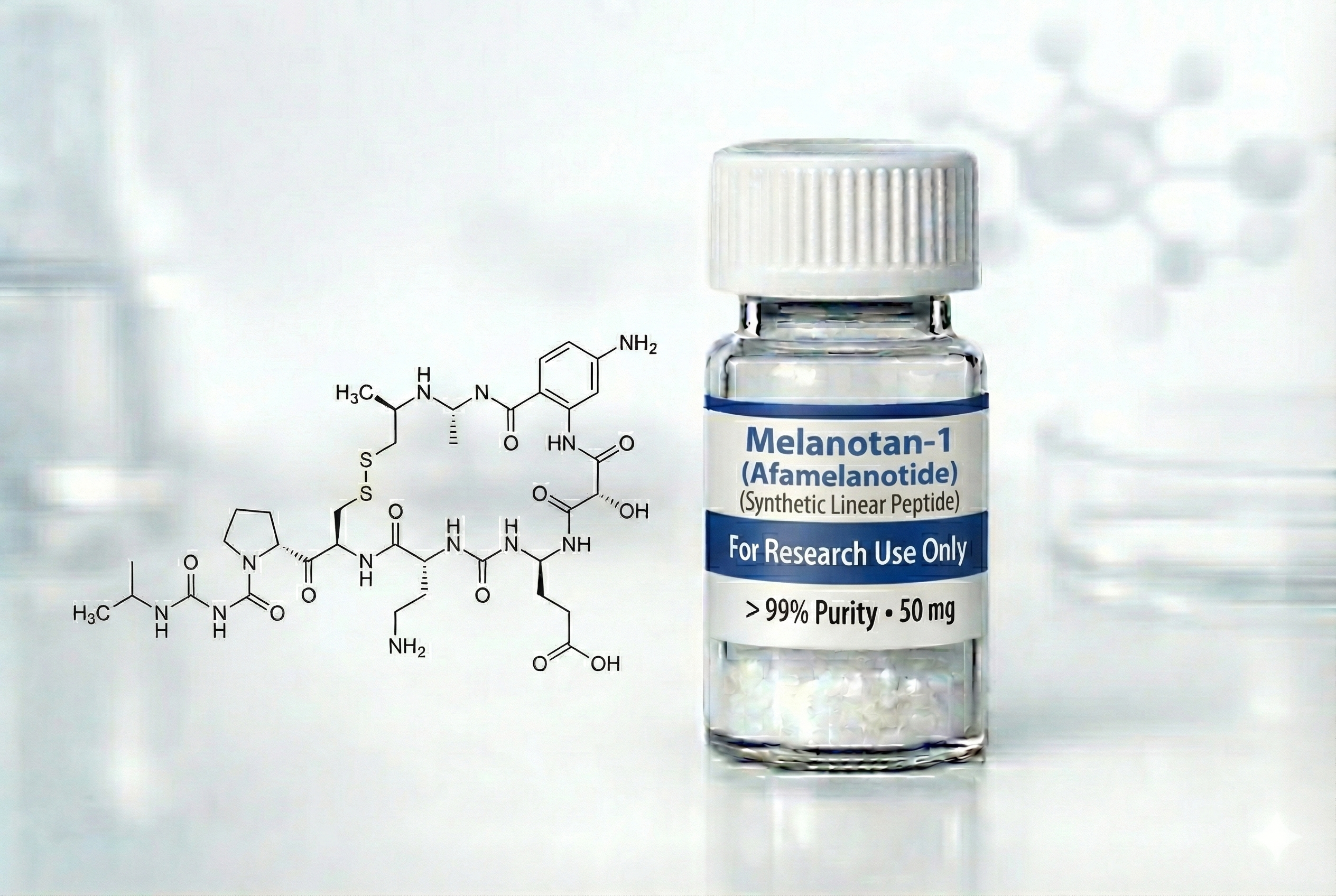
Melanotan-1 (Afamelanotide Acetate)

Melanotan-1 (Afamelanotide) is a synthetic peptide that stimulates melanin production in the skin, providing photoprotection and a deeper, longer-lasting tan. Unlike Melanotan-2, it acts peripherally without central nervous system side effects. While clinically studied for phototoxicity, it is not FDA-approved for cosmetic use and is available only as a research chemical.

Price range: $40.00 through $50.00

- +

Description

Melanotan-1 is a synthetic peptide modification of the endogenous hormone alpha-melanocyte stimulating hormone (α-MSH), a key regulator of pigmentation produced in the pituitary gland. Its chemical structure, chemically known as [Nle4, D-Phe7]-α-MSH, involves replacing the Met4 residue with Norleucine and the Phe7 residue with D-Phenylalanine.⁹ These structural modifications shield the peptide from rapid enzymatic breakdown, extending its half-life from mere minutes (for natural α-MSH) to a duration sufficient to therapeutically activate skin receptors.

Identity & Terminology:

  • Generic Name: Afamelanotide (the International Nonproprietary Name used in medical literature).
  • Research Name: Melanotan-1, MT-1, or sometimes “Melanotan I.”
  • Structure: A linear tridecapeptide (13 amino acids), distinct from the shorter, cyclic structure of Melanotan-2.

Routes of Administration:

  • Subcutaneous Injection: This is the standard and most effective method for cosmetic and research use. The peptide is typically sold as a sterile, freeze-dried (lyophilized) white powder in a glass vial. Users must reconstitute it with bacteriostatic water and administer it using an insulin syringe into fatty tissue (adipose), such as the abdomen. Because Melanotan-1 is less potent by weight than Melanotan-2, it often requires a “loading phase” of daily injections to reach saturation levels in the skin.¹⁰
  • Nasal Spray: While occasionally marketed, the nasal bioavailability of linear peptides like Melanotan-1 is poor. The large molecule struggles to cross the nasal mucosa effectively, leading to inconsistent dosing and wasted product compared to injection.

Regulatory Status:

  • FDA Status: Injectable Melanotan-1 for cosmetic tanning is not FDA-approved. The agency has issued warnings regarding unregulated “tanning shots,” citing concerns over sterility and the lack of oversight in the research chemical market.¹¹ While the molecule afamelanotide is medically approved in an implantable form for rare genetic disorders, the liquid injectable vials sold online are technically “research chemicals” not intended for human use.
  • Availability: It is widely available through online peptide vendors, compounding pharmacies (in some jurisdictions), and anti-aging clinics operating in regulatory grey areas.
How It Works

Specificity Matters: MC1R Agonism

The human body possesses five different melanocortin receptors (MC1R through MC5R), each controlling different physiological functions ranging from pigmentation to sexual function and energy homeostasis. Melanotan-1 is unique in its high specificity for the MC1R receptor found on skin cells.¹²

Mechanism of Action:

  1. Receptor Activation: Upon injection, Melanotan-1 travels through the bloodstream to the skin, where it binds with high affinity to MC1R on the surface of melanocytes.
  2. Eumelanin Production: This binding activates the enzyme tyrosinase, the rate-limiting step in pigment production. Crucially, it shifts the balance of pigment production from pheomelanin (the reddish-yellow pigment associated with burning and poor UV protection) to eumelanin (the brown-black pigment that absorbs UV light).³
  3. The “Super-Umbrella” Effect: The newly produced eumelanin is packaged into melanosomes and transported to keratinocytes (skin cells). There, it forms a protective “cap” over the cell nucleus, absorbing incoming UV radiation and scavenging free radicals before they can damage DNA. This biological tanning provides a measurable Sun Protection Factor (SPF), reducing the risk of sunburn.³

Melanotan-1 vs. Melanotan-2: The Critical Difference

The primary reason users choose Melanotan-1 over the more popular Melanotan-2 is the side effect profile. Melanotan-2 is a “shotgun” agonist—it activates MC1R (skin), but also MC3R and MC4R in the brain. This central activation causes severe nausea, appetite suppression, and spontaneous sexual arousal.

Melanotan-1, being a larger linear molecule, does not cross the blood-brain barrier as easily and has lower affinity for the central receptors. This makes it a “pure” tanning agent. It allows users to darken their skin without the uncomfortable physical sensations or unwanted sexual side effects of MT-2.⁴

Feature

Melanotan-1

Melanotan-2 (MT-2)

Selectivity

Highly selective for Skin (MC1R)

Non-selective; hits Brain (MC3R/4R)

Primary Effect

Pigmentation / Photoprotection

Pigmentation + Libido + Fat Loss

Side Effects

Mild flushing, minor nausea

Severe nausea, erections, anxiety

Dosing

Higher doses (1mg+), daily loading

Micro-doses (0.1mg-0.5mg) effective

User Profile

Those seeking tan only w/o side effects

Those seeking tan plus libido/diet aid

Research Evidence

Tanning & Photoprotection Efficacy

DNA Protection & The “Sunburn Cell” Study

Design: This randomized, double-blind, placebo-controlled study is the gold standard for Melanotan-1’s efficacy. It involved healthy subjects with Fitzpatrick skin types I-IV (fair to medium). Participants received subcutaneous injections of Melanotan-1 or saline over 4 weeks, combined with controlled doses of solar UV radiation to the neck and back.

Key Results:

  • Deep Tanning: Subjects in the peptide group achieved significantly deeper tanning (measured by chromometer) compared to the placebo group, even with identical UV exposure.
  • Reduced DNA Damage: Skin biopsies taken after UV exposure showed 47% fewer “sunburn cells” (apoptotic cells) in the Melanotan-1 group.
  • Thymine Dimers: The study also measured hydrogen peroxide-stable thymine dimers (a specific type of DNA damage linked to cancer) and found significantly lower levels in the peptide-treated skin.
  • Conclusion: The authors concluded that Melanotan-1 is not just a cosmetic agent but a “chemopreventive” one that enhances the skin’s biological barrier against UV injury.³

Proof of Concept in Fair Skin

Findings: This early landmark study demonstrated that Melanotan-1 could induce tanning even in individuals who historically burn and never tan. Subjects who received the peptide developed a tan at body sites that were not exposed to the sun, confirming the systemic nature of the drug. However, the study noted that the tan was enhanced by UV light, establishing the “synergistic” protocol used by modern cosmetic users (Peptide + minimal UV = Maximum Tan).

Current Status

The “Research Chemical” Market Reality

Because the pharmaceutical version of afamelanotide is strictly controlled (and available only as an implant), the only source for cosmetic users is the unregulated “research chemical” market.

  • Purity & Safety: Vials sold online are labeled “Not for Human Consumption.” While many vendors sell legitimate peptides, there is a risk of contamination, under-dosing, or mislabeling (e.g., selling cheap Melanotan-2 labeled as the more expensive Melanotan-1). Users typically rely on third-party HPLC testing reports to verify the identity of the substance.⁸
  • Cost Dynamics: Melanotan-1 is generally more expensive to run than Melanotan-2. A 10mg vial of MT-2 might last a user months due to micro-dosing, whereas a 10mg vial of MT-1 might only last 2 weeks during a loading phase.

Practical Dosing Protocols

User reports and grey-market guides suggest a distinct protocol for Melanotan-1 compared to other peptides:¹⁰

  • Loading Phase: Because it is less potent, users often inject 1mg (1000mcg) daily for the first 1-2 weeks until the desired base color is achieved.
  • Maintenance Phase: Once tan, dosing is reduced to 1-2 times per week to maintain pigment.
  • UV Synergy: While the peptide darkens skin alone, users report that results are 5-10x faster if injections are timed 30 minutes before a brief sunbed session or natural sun exposure.
  • Storage: The reconstituted peptide must be kept refrigerated to prevent degradation.

Safety & Side Effects

  • Nausea: While significantly milder than MT-2, mild nausea can still occur, particularly during the first few injections as the body adjusts.
  • Mole Darkening (Hyperpigmentation): A common, cosmetic side effect is the darkening of existing moles and freckles. Because these areas already have high melanocyte density, they darken faster than the surrounding skin. This effect typically reverses after discontinuing the drug.⁵
  • Injection Site Reactions: Small bruises or redness at the injection site are common but generally resolve quickly.

Disclaimer

Injectable Melanotan-1 is not FDA-approved for cosmetic tanning.

Products sold online as “research chemicals” are unregulated, may contain impurities, and are not intended for human consumption.

While Melanotan-1 avoids many of the central nervous system side effects of Melanotan-2, the use of melanotropic peptides can cause side effects such as nausea, facial flushing, and the darkening of moles.

This content is for educational purposes only and does not constitute medical advice.

Reviews

There are no reviews yet.

Be the first to review “Melanotan-1 (Afamelanotide Acetate)”

Your email address will not be published. Required fields are marked *

Latest News

Latest Research Updates

Curated news and publications on peptides, metabolic research, and cellular energy modulation.
Melanotan-1 (Afamelanotide Acetate)Melanotan-1 (Afamelanotide Acetate)
Price range: $40.00 through $50.00Select options