CagrilintideJavelin Sciences Adds the World’s First Topical KLOW80 Peptide Formula to Research Offerings – Knoxville News Sentinel
Javelin Sciences Adds the World’s First Topical KLOW80 Peptide Formula to Research Offerings Knoxville News Sentinel
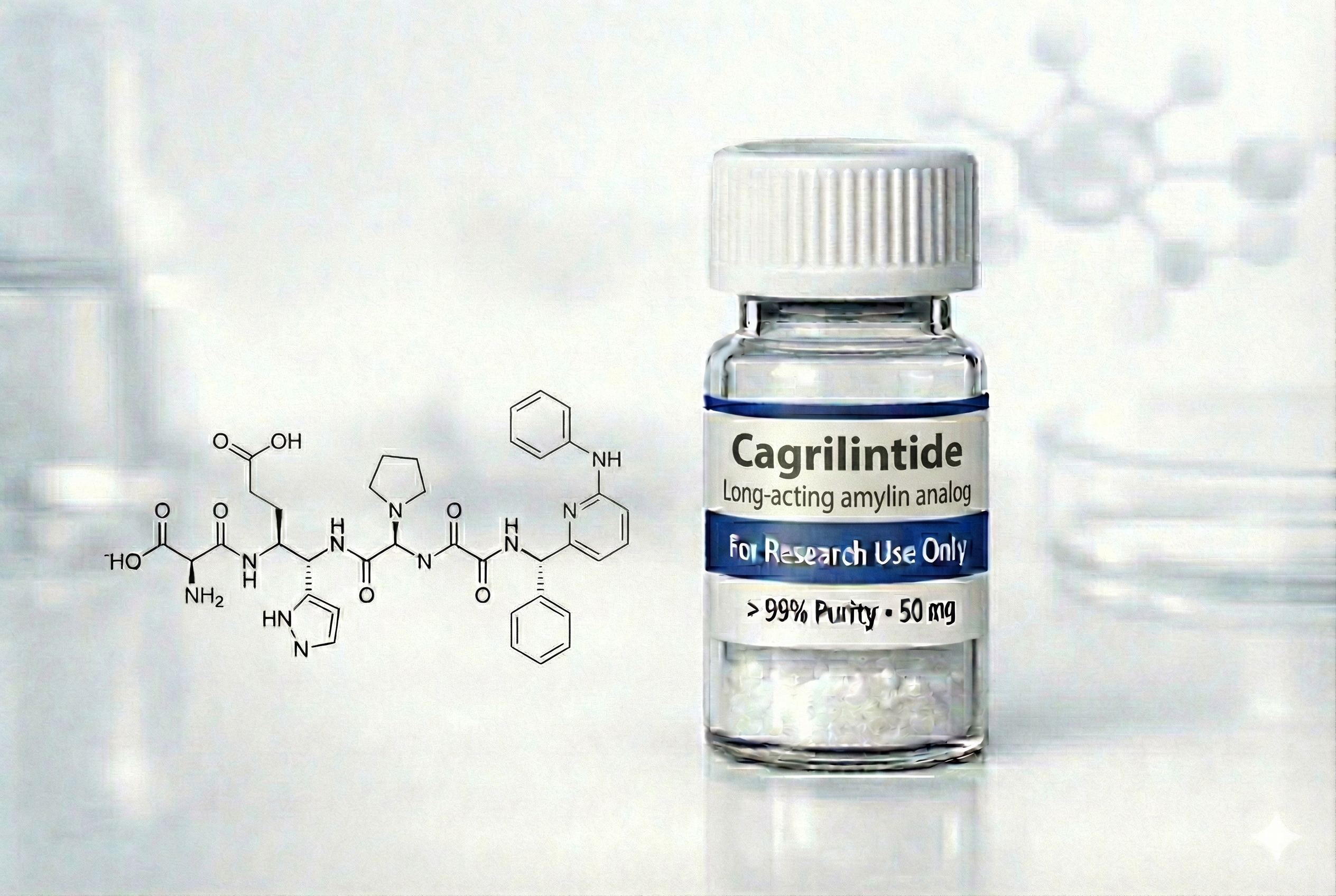
Cagrilintide is a long-acting lipidated amylin analog under investigation for weight management and metabolic health.¹ ² Designed to overcome the short half-life and instability challenges of native amylin and its predecessor pramlintide, cagrilintide targets amylin receptors in the brain to reduce appetite, slow gastric emptying, and promote satiety.¹ ³ Clinical trials demonstrate significant weight loss both as monotherapy and in combination with the GLP-1 receptor agonist semaglutide (marketed as CagriSema), with Phase 3 data showing up to 22.7% mean weight reduction.⁴ ⁵
$375.00
Cagrilintide represents a significant advancement in peptide-based metabolic therapeutics, addressing the inherent challenges of native human amylin—a 37-amino acid pancreatic hormone with high propensity for amyloid fibril formation and extremely short half-life.¹ As a lipidated amylin analog, cagrilintide incorporates strategic amino acid substitutions and fatty acid acylation to achieve once-weekly dosing while maintaining receptor selectivity and potency.¹
The peptide is based on the pramlintide backbone with key modifications including introduction of a salt bridge (positions 14E and 17R), C-terminal proline substitutions (25P, 28P, 29P, 37P), and N-terminal conjugation with a C20 fatty diacid via γ-glutamic acid linker.¹ These modifications increase solubility across physiological pH ranges, prevent fibril formation, enable reversible albumin binding for extended half-life (159-195 hours), and preserve receptor activity at both calcitonin receptors (CTR) and amylin receptors (AMY₁R, AMY₂R, AMY₃R).¹ ⁶
Unlike GLP-1 receptor agonists that primarily target pancreatic and gastrointestinal pathways, cagrilintide acts centrally through amylin receptors concentrated in the area postrema and nucleus of the solitary tract in the brainstem, providing complementary mechanisms for appetite suppression and metabolic regulation.⁶ ⁷
Mechanism of Action
Cagrilintide exerts its metabolic effects through multiple interconnected pathways centered on brain amylin receptor activation:⁶ ⁷
Central Nervous System Targeting: The primary site of action is the area postrema (AP), a circumventricular organ in the caudal hindbrain lacking a complete blood-brain barrier.⁶ ⁷ From the AP, signals propagate to the nucleus of the solitary tract (NTS) and lateral parabrachial nucleus (LPBN), creating an integrated satiety response.⁶ This central mechanism distinguishes cagrilintide from peripherally-acting obesity medications.
Amylin Receptor Selectivity: Cagrilintide functions as a non-selective agonist across the calcitonin receptor family, activating CTR, AMY₁R, and AMY₃R with balanced potency (EC₅₀ values of 49-62 pM on human receptors).¹ ⁶ Recent research demonstrates that both AMY₁R and AMY₃R contribute to cagrilintide’s body weight-lowering effects, with receptor-specific knockout studies revealing complementary roles in metabolic regulation.⁶
Unlike salmon calcitonin which exhibits prolonged receptor residence time (45-60 minutes), cagrilintide displays rapid dissociation kinetics (3-6 minutes) comparable to pramlintide, potentially contributing to reduced nausea and vomiting compared to calcitonin-based therapies.⁶ Cryogenic electron microscopy studies confirm that cagrilintide activates amylin receptors through mechanisms distinct from calcitonin, with different receptor conformations and downstream signaling pathway recruitment.⁶
Pharmacokinetic Profile: N-terminal lipidation with a C20 fatty diacid enables reversible albumin binding, extending the terminal half-life to 159-195 hours in humans—enabling true once-weekly dosing.¹ ³ The subcutaneous bioavailability approaches 30% in preclinical models, with distribution primarily to pancreas, pineal body, thyroid, liver, and kidney cortex.¹ The compound does not penetrate the intact blood-brain barrier but accesses circumventricular organs with fenestrated capillaries.¹
Physiological Effects
Appetite Regulation: In animal models, cagrilintide reduces food intake by 40-85% at doses of 3-30 nmol/kg, with effects persisting 48-60 hours after a single injection.¹ This sustained anorectic effect results from prolonged amylin receptor engagement in appetite-regulating brain regions.
Gastric Emptying: Amylin receptor activation slows gastric emptying, prolonging nutrient absorption and enhancing satiety signals.² This effect complements GLP-1 agonist mechanisms when used in combination therapy.
Energy Expenditure: Preclinical studies suggest cagrilintide may influence energy expenditure through modulation of metabolic pathways, though the magnitude is less pronounced than the appetite-suppressing effects.¹
Glucose Regulation: While primarily developed for obesity, cagrilintide demonstrates glucose-lowering effects in individuals with type 2 diabetes through reduced caloric intake and potential direct effects on pancreatic hormone secretion.⁵ ⁸
Primary Clinical Studies
Study 1: Lau DCW et al., 2021 – Once-weekly cagrilintide for weight management in people with overweight and obesity: a phase 2, randomised, double-blind, placebo-controlled and active-controlled trial
Design: Phase 2, randomized, double-blind trial in 706 adults with overweight or obesity (BMI ≥27 kg/m²) without diabetes. Participants received once-weekly subcutaneous cagrilintide (0.3-4.5 mg), liraglutide 3.0 mg daily, or placebo for 26 weeks with 6-week follow-up.²
Results:
Significance: First demonstration in humans that a long-acting amylin analog produces clinically meaningful weight loss with once-weekly dosing, validating the therapeutic potential of amylin receptor targeting for obesity.²
Study 2: Garvey WT et al., 2025 – Coadministered Cagrilintide and Semaglutide in Adults with Overweight or Obesity (REDEFINE 1)
Design: Phase 3a, randomized, double-blind, placebo-controlled trial in 3,417 adults without type 2 diabetes with BMI ≥30 kg/m² (or ≥27 kg/m² with obesity-related complications). Participants received once-weekly cagrilintide-semaglutide 2.4 mg/2.4 mg (CagriSema), semaglutide 2.4 mg alone, cagrilintide 2.4 mg alone, or placebo for 68 weeks with lifestyle intervention.⁴
Results:
Significance: Largest obesity trial to date demonstrating that dual amylin-GLP-1 receptor agonism produces unprecedented weight loss exceeding either monotherapy, with 60% of participants achieving ≥20% weight reduction—approaching bariatric surgery outcomes.⁴
Study 3: Davies MJ et al., 2025 – Cagrilintide-Semaglutide in Adults with Overweight or Obesity and Type 2 Diabetes (REDEFINE 2)
Design: Phase 3a, randomized, double-blind, placebo-controlled trial in 1,206 adults with type 2 diabetes, BMI ≥27 kg/m², and HbA1c 7-10%. Participants received once-weekly cagrilintide-semaglutide 2.4 mg/2.4 mg or placebo with lifestyle intervention for 68 weeks.⁵
Results:
Significance: First demonstration that combined amylin-GLP-1 therapy provides superior weight loss and glycemic control in adults with type 2 diabetes compared to placebo, addressing the dual challenges of obesity and diabetes management with a single weekly injection.⁵ ⁸
Development and Mechanistic Studies
Kruse T et al., 2021 – Development of Cagrilintide, a Long-Acting Amylin Analogue
Comprehensive medicinal chemistry study detailing:
Significance: Definitive account of the medicinal chemistry challenges and solutions enabling transformation of an unstable, short-acting peptide hormone into a stable, long-acting therapeutic agent suitable for once-weekly dosing.¹
Sonne N et al., 2025 – Cagrilintide lowers bodyweight through brain amylin receptors 1 and 3
Mechanistic study using receptor knockout mice and cellular assays:
Significance: Elucidates the receptor pharmacology underlying cagrilintide’s clinical effects and differentiates its mechanism from calcitonin-based approaches, explaining reduced adverse event profile.⁶
Research Status
As of January 2026, cagrilintide has completed Phase 3 clinical development both as monotherapy and in combination with semaglutide (CagriSema).⁴ ⁵ Regulatory submissions to the FDA and EMA are anticipated in 2025-2026 based on positive REDEFINE 1 and REDEFINE 2 trial results.⁴ ⁵ The compound is not currently FDA-approved for any indication and remains available only for research applications.
The development program represents one of the largest obesity clinical trial efforts to date, with the REDEFINE studies enrolling over 4,600 participants across 12+ countries with comprehensive safety and efficacy assessments over 68-week treatment periods.⁴ ⁵
Potential Therapeutic Applications
Obesity Management: Clinical trials demonstrate that CagriSema (cagrilintide 2.4 mg + semaglutide 2.4 mg) produces mean weight loss of 22.7% in adults without diabetes and 15.7% in those with type 2 diabetes—representing the highest weight reduction achieved with pharmacotherapy to date.⁴ ⁵ The proportion of participants achieving ≥20% weight loss (60% without diabetes, approaching bariatric surgery outcomes) positions this combination as a potential first-line alternative to surgical intervention.⁴
Type 2 Diabetes with Obesity: The REDEFINE 2 trial demonstrates dual metabolic benefits in adults with type 2 diabetes—significant weight loss combined with glycemic control (74% achieving HbA1c ≤6.5%, suggesting diabetes remission potential).⁵ ⁸ The low hypoglycemia incidence makes this combination particularly attractive for patients with obesity and diabetes.⁵
Metabolic Syndrome Research: The combination of appetite suppression, delayed gastric emptying, improved insulin sensitivity, and weight-dependent metabolic improvements positions cagrilintide-based therapies for broader metabolic syndrome research applications.²
Comparative Efficacy Research: With demonstrated superiority over both GLP-1 monotherapy and cagrilintide monotherapy, the combination provides unique opportunities to study complementary mechanisms in metabolic regulation and identify optimal multi-target approaches.⁴
Safety Profile Summary
Across Phase 2 and Phase 3 clinical trials involving thousands of participants over treatment durations up to 68 weeks:² ⁴ ⁵
Gastrointestinal Effects: Most common adverse events include nausea, diarrhea, constipation, and vomiting—consistent with GLP-1 receptor agonist class effects. Most events are mild-to-moderate in severity and diminish over time with dose escalation protocols.² ⁴ ⁵
Treatment Discontinuation: Discontinuation rates due to adverse events remain acceptable (10% in Phase 2 monotherapy, similar across treatment arms in Phase 3 studies), suggesting good overall tolerability despite higher weight loss magnitude.² ⁴ ⁵
Cardiovascular Safety: No increased cardiovascular risk signals observed in clinical trials to date, though dedicated cardiovascular outcomes trials will be required for regulatory approval.⁴ ⁵
Hypoglycemia: Low incidence in patients not receiving sulfonylureas or insulin, with rates comparable to placebo—an important safety advantage over some diabetes medications.⁵
Pancreatitis and Thyroid: No increased rates of pancreatitis or thyroid adverse events observed, though long-term surveillance continues as with all incretin-based therapies.⁴ ⁵
Injection Site Reactions: Minimal injection site reactions reported, confirming that formulation strategies successfully prevented the fibril formation and injection site necrosis observed in early development candidates.¹
Important Considerations
Not FDA-Approved: Cagrilintide and CagriSema are investigational medications not approved for any use. All products are intended strictly for laboratory research purposes.
Combination Therapy Design: The most impressive clinical results derive from combination therapy with semaglutide, suggesting that dual receptor targeting provides complementary mechanisms superior to either pathway alone.⁴ This highlights the importance of multi-target approaches in complex metabolic diseases.
Dose Escalation Requirements: Clinical protocols utilize gradual dose escalation over 6-12 weeks to minimize gastrointestinal adverse events, requiring patient education and adherence support for optimal outcomes.² ⁴ ⁵
Cost-Effectiveness Considerations: While not yet priced, the combination of two complex peptide therapeutics will likely carry significant cost, raising questions about access and cost-effectiveness relative to existing GLP-1 monotherapies and bariatric surgery.
Long-Term Weight Maintenance: As with all obesity pharmacotherapies, treatment discontinuation typically results in weight regain, emphasizing the need for indefinite therapy or effective transition strategies to maintain metabolic benefits.⁴ ⁵

Primary Clinical Studies
Lau DCW, Blüher M, Aronne LJ, et al. Once-weekly cagrilintide for weight management in people with overweight and obesity: a phase 2, randomised, double-blind, placebo-controlled and active-controlled trial. The Lancet. 2021;398(10317):2160-2172. doi:10.1016/S0140-6736(21)01751-7.
Garvey WT, Blüher M, Osorto Contreras CK, et al. Coadministered cagrilintide and semaglutide in adults with overweight or obesity. New England Journal of Medicine. 2025;393(7):635-647. doi:10.1056/NEJMoa2500779. PMID: 40544433.
Davies MJ, Aronne LJ, Caterson ID, et al. Cagrilintide-semaglutide in adults with overweight or obesity and type 2 diabetes. New England Journal of Medicine. 2025;393(7):648-661. doi:10.1056/NEJMoa2500778. PMID: 40544432.
Development and Mechanistic Studies
Kruse T, Hansen JL, Dahl K, et al. Development of Cagrilintide, a Long-Acting Amylin Analogue. Journal of Medicinal Chemistry. 2021;64(15):11183-11194. doi:10.1021/acs.jmedchem.1c00565.
Sonne N, Karsdal MA, Henriksen K, et al. Cagrilintide lowers bodyweight through brain amylin receptors 1 and 3. eBioMedicine. 2025;111:105440. doi:10.1016/j.ebiom.2024.105440.
Comprehensive Reviews
Pieber TR, Hoefler J. Cagrilintide: A long-acting amylin analog for the treatment of obesity. Expert Opinion on Investigational Drugs. 2023;32(12):1183-1190.
Hay DL, Chen S, Lutz TA, et al. Amylin: Pharmacology, Physiology, and Clinical Potential. Pharmacological Reviews. 2015;67(3):564-600.
This content is for educational and research purposes only and does not constitute medical advice. Cagrilintide is not FDA-approved for human use. All products are intended strictly for laboratory research and development purposes only.
Javelin Sciences Adds the World’s First Topical KLOW80 Peptide Formula to Research Offerings Knoxville News Sentinel
Javelin Sciences Adds the World’s First Topical KLOW80 Peptide Formula to Research Offerings Columbia Daily Tribune
Fungal Peptide Boosts Intestinal Repair in Mice Bioengineer.org
Added to cart
Check out our shop to see what's available
Cagrilintide