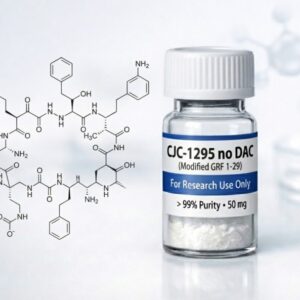
CJC-1295 no DAC (Modified GRF 1-29)

Review article author: Sigalos JT & Pastuszak AW (2017)

Primary clinical study: Corpas E et al. (1992)

CJC-1295 no DAC, also known as Modified GRF 1-29 or Mod GRF 1-29, is a stabilized analog of growth hormone-releasing hormone (GHRH) consisting of the first 29 amino acids with four strategic substitutions to resist enzymatic degradation.¹ ² Unlike CJC-1295 with DAC which has an extended 6-8 day half-life, Modified GRF 1-29 has a short half-life of approximately 30 minutes, requiring multiple daily administrations (typically 2-3 times daily) to maintain elevated growth hormone (GH) secretion.³ ⁴ The landmark 1992 Corpas study demonstrated that twice-daily subcutaneous administration of GHRH(1-29) to elderly men reversed age-related decreases in GH and IGF-I levels, restoring them to young adult values without adverse effects on glucose metabolism or blood pressure.² However, systematic reviews emphasize that while GH secretagogues successfully elevate biomarkers, evidence for functional outcomes (body composition, strength, quality of life) remains limited and requires larger, longer-duration trials.¹

$185.00

- +

Description:

Modified GRF 1-29 (CJC-1295 no DAC) is a 29-amino acid synthetic peptide analog of the N-terminal bioactive fragment of human growth hormone-releasing hormone (GHRH 1-44).¹ ⁵ The compound retains the complete biological activity of native GHRH while incorporating four amino acid substitutions at positions 2, 8, 15, and 27 (D-Ala², Gln⁸, Ala¹⁵, Leu²⁷) that significantly increase resistance to enzymatic cleavage by dipeptidyl peptidase-IV (DPP-IV) and other peptidases.⁴ ⁵ ⁶

These structural modifications extend the functional half-life from approximately 7 minutes (native GHRH) to approximately 30 minutes, making subcutaneous or intramuscular administration practical while preserving physiological pulsatile GH secretion patterns.⁴ ⁶ The most critical modification, D-Ala at position 2, prevents rapid N-terminal degradation by DPP-IV and increases the elimination half-life by approximately 50% compared to unmodified GHRH(1-29).⁶

Modified GRF 1-29 is pharmacologically distinct from CJC-1295 with DAC, which incorporates a Drug Affinity Complex enabling albumin binding and multi-day duration of action.³ While both compounds stimulate GH release through GHRH receptor (GHRH-R) activation, their dramatically different pharmacokinetic profiles create distinct use cases:³ ⁴

  • Modified GRF 1-29 (no DAC): Half-life ~30 minutes, requires 2-3 daily injections, mimics physiological pulsatile GH secretion more closely
  • CJC-1295 with DAC: Half-life 6-8 days, dosed weekly or biweekly, provides sustained GH elevation

The shorter duration of Modified GRF 1-29 offers potential advantages including more precise timing with meals and exercise, reduced risk of excessive IGF-I elevation, and the ability to rapidly discontinue if adverse effects occur.³ ⁴ Conversely, the convenience of less frequent administration makes the DAC version attractive for different applications.³

Modified GRF 1-29 functions as a GHRH mimetic, binding to GHRH-R on pituitary somatotrophs and activating G-protein coupled signaling cascades involving cyclic AMP (cAMP) production and protein kinase A pathways.¹ When combined with growth hormone-releasing peptides (GHRPs) that act through the ghrelin receptor (GHS-R), Modified GRF 1-29 produces synergistic GH release substantially exceeding either compound alone—a property commonly exploited in combination protocols with ipamorelin, GHRP-2, or GHRP-6.¹ ⁵


How It Works


Mechanism of Action

Modified GRF 1-29 operates through the hypothalamic-pituitary-somatotropic axis by directly activating GHRH receptors on anterior pituitary somatotroph cells:¹ ⁴ ⁵

GHRH Receptor Activation: Upon binding to GHRH-R, a seven-transmembrane domain G-protein coupled receptor, Modified GRF 1-29 activates adenylyl cyclase through Gs proteins, increasing intracellular cAMP concentrations.¹ ⁴ Elevated cAMP activates protein kinase A (PKA), which phosphorylates transcription factors including cAMP response element-binding protein (CREB).¹ This cascade upregulates GH gene transcription and stimulates immediate GH secretion from stored granules in somatotroph cells.¹

Pulsatile Secretion Preservation: Unlike exogenous GH administration which provides constant, non-physiological hormone levels and suppresses endogenous production through negative feedback, Modified GRF 1-29 stimulates the body’s own pulsatile GH secretion pattern.¹ ⁵ ⁷ This pulsatility is critical for normal GH function and maintains negative feedback regulation through somatostatin and IGF-I, preventing the supratherapeutic levels associated with recombinant GH therapy complications including edema, carpal tunnel syndrome, and glucose intolerance.¹ ⁷

Pituitary Gene Transcription: A unique advantage of GHRH analogs over exogenous GH is stimulation of pituitary gene transcription of GH messenger RNA, increasing pituitary GH reserves and preserving the growth hormone neuroendocrine axis function.⁷ This “pituitary recrudescence” may help slow the cascade of hypophyseal hormone failure that occurs during aging, maintaining not only youthful hormone levels but also physiological feedback mechanisms.⁷

Enhanced Stability: The four amino acid substitutions in Modified GRF 1-29 specifically target enzymatic cleavage sites:⁴ ⁵ ⁶

  • D-Ala² substitution: Prevents DPP-IV cleavage at the N-terminus, the primary site of rapid degradation
  • Gln⁸, Ala¹⁵, Leu²⁷ substitutions: Reduce susceptibility to endopeptidases and enhance overall molecular stability

These modifications extend the functional half-life to approximately 30 minutes while maintaining full agonist activity at GHRH-R (potency equivalent to or slightly enhanced compared to native GHRH).⁵ ⁶

Pharmacokinetics: Following subcutaneous or intramuscular injection, Modified GRF 1-29 reaches peak plasma concentrations within 15-30 minutes, with maximal GH secretion occurring 30-60 minutes post-administration.⁴ ⁵ The elimination half-life of approximately 30 minutes necessitates dosing 2-3 times daily to maintain elevated GH secretory capacity, typically timed before meals or exercise to maximize physiological synergy with endogenous GH pulses.⁴ ⁵

IGF-I Production: Pulsatile GH elevation stimulates hepatic and peripheral tissue production of insulin-like growth factor-I (IGF-I), the primary mediator of GH’s anabolic effects.¹ ² The Corpas study demonstrated that twice-daily GHRH(1-29) administration to elderly men increased 24-hour integrated IGF-I concentrations from 149±9 ng/mL (baseline) to 229±22 ng/mL (high dose), restoring levels to those observed in young men (259±28 ng/mL).² IGF-I exerts anabolic effects on muscle, bone, and connective tissues while providing negative feedback to regulate GH secretion.¹ ²

Synergy with GHRPs: When combined with growth hormone-releasing peptides that act through the ghrelin receptor (GHS-R), Modified GRF 1-29 produces synergistic GH release 5-10 times greater than either compound alone.¹ ⁵ This synergy results from complementary mechanisms—GHRH analogs increase GH synthesis and release amplitude, while GHRPs suppress somatostatin inhibition and enhance GH pulse frequency.¹ Common combination protocols include Modified GRF 1-29 + ipamorelin, which is reported to provide robust GH elevation without stimulating cortisol or prolactin (side effects associated with other GHRPs).⁵

Physiological Effects

The downstream effects of elevated GH and IGF-I include:¹ ² ⁷

  • Body Composition: Increased lean body mass and reduced fat mass, particularly visceral adipose tissue
  • Bone Metabolism: Increased bone turnover markers; increased serum phosphate reflecting enhanced bone mineralization²
  • Protein Synthesis: Enhanced muscle protein synthesis and nitrogen retention
  • Lipolysis: Increased fat mobilization and oxidation
  • Collagen Synthesis: Improved connective tissue health and wound healing
  • Metabolic Effects: The Corpas study found no adverse effects on fasting glucose or insulin despite significant GH/IGF-I elevation, suggesting GHRH-stimulated GH may have different metabolic profile than pharmacological GH administration²

Research Evidence


Primary Clinical Study

Corpas E et al., 1992 – Growth hormone (GH)-releasing hormone-(1-29) twice daily reverses the decreased GH and insulin-like growth factor-I levels in old men

Design: Prospective study in healthy young men (n=9, age 26.2±4.1 years) and healthy elderly men (n=10, age 68.0±6.2 years) examining whether subcutaneous GHRH(1-29) administration restores age-related GH deficiency.²

Study Protocol:

  • Baseline: 24-hour GH secretion profiles and IGF-I measurements in both age groups
  • IV bolus GHRH stimulation testing to confirm pituitary responsiveness
  • Elderly men received GHRH-(1-29) subcutaneously twice daily (morning and bedtime) in randomized crossover design:
    • Low dose: 0.5 mg (500 µg) twice daily for 14 days
    • High dose: 1 mg (1000 µg) twice daily for 14 days
    • 14-day washout period between treatment phases
  • Repeat 24-hour GH profiles and laboratory assessments on day 14 of each treatment

*Results – GH Secretion:*²

  • Baseline age-related decline: Elderly men had dramatically reduced 24-hour integrated GH concentrations (22.1±5.6 µg/L) compared to young men (140.4±35.8 µg/L), representing 84% reduction
  • Low dose GHRH treatment: Increased 24-hour integrated GH to 79.9±15.6 µg/L (361% increase vs. baseline, p<0.05)
  • High dose GHRH treatment: Increased 24-hour integrated GH to 116.9±30.1 µg/L (529% increase vs. baseline, p<0.01)
  • High-dose treatment restored GH levels to approximately 83% of young adult values
  • GH pulse amplitude increased significantly with both doses; pulse frequency unchanged

*Results – IGF-I Levels:*²

  • Baseline: Elderly men had reduced IGF-I (149±9 ng/mL) vs. young men (259±28 ng/mL), representing 42% reduction
  • Low dose: Increased IGF-I to 177±11 ng/mL (19% increase, p<0.05)
  • High dose: Increased IGF-I to 229±22 ng/mL (54% increase, p<0.01)
  • High-dose treatment restored IGF-I to 88% of young adult values

*Results – Body Composition and Metabolism:*²

  • Serum phosphate: Increased significantly during both GHRH treatment periods (p<0.05), reflecting enhanced bone metabolism and mineralization
  • Fasting glucose: No significant changes with either dose
  • Urinary C-peptide: No significant changes, indicating preserved pancreatic beta-cell function
  • Blood pressure: No changes in systolic or diastolic blood pressure
  • Chemistry and hematology: No clinically significant adverse changes in comprehensive metabolic panels

*Safety Profile:*²

  • Well-Tolerated: Both doses well-tolerated with minimal adverse effects
  • Injection Site Reactions: Transient mild discomfort at injection sites most common complaint
  • No Hypoglycemia: No episodes of hypoglycemia despite GH elevation
  • No Edema or Fluid Retention: No peripheral edema or signs of fluid retention (common with recombinant GH therapy)
  • Preserved Glucose Metabolism: Unlike recombinant GH which often causes insulin resistance, GHRH treatment did not adversely affect glucose or insulin parameters

*Limitations:*²

  • Small sample size (N=10 elderly men treated)
  • Short study duration (14 days per treatment period)
  • No functional outcome measures (body composition, strength, quality of life not assessed)
  • Healthy elderly men only—effects in frail elderly or those with comorbidities unknown
  • Twice-daily injection burden may limit long-term compliance
  • No long-term safety data beyond 28 total days of exposure

Significance: Landmark study establishing proof-of-concept that subcutaneous GHRH(1-29) administration safely reverses age-related GH and IGF-I deficiency in elderly men, restoring levels to young adult values without adverse metabolic effects. The preservation of normal glucose metabolism despite significant GH elevation distinguishes GHRH therapy from recombinant GH, suggesting potentially superior safety profile for age-related applications.²

Comprehensive Review Context

Sigalos JT & Pastuszak AW, 2017 – The Safety and Efficacy of Growth Hormone Secretagogues

*Systematic review of growth hormone secretagogues including GHRPs and GHRH analogs, examining safety and efficacy across therapeutic applications.*¹

Key Context for Modified GRF 1-29:

  • Theoretical Advantages over Exogenous GH: Growth hormone secretagogues promote pulsatile GH release subject to negative feedback via somatostatin and IGF-I, potentially preventing supratherapeutic levels and associated adverse effects (edema, carpal tunnel syndrome, glucose intolerance) seen with recombinant GH therapy¹
  • Synergistic Mechanisms: GHRH analogs synergize with GHRPs through complementary pathways—GHRH-R vs. GHS-R activation—producing GH responses 5-10 fold greater than either compound alone¹
  • Sermorelin (GHRH 1-29) FDA Approval: The parent compound sermorelin received FDA approval for diagnostic testing of GH secretory capacity and treatment of pediatric GH deficiency, establishing regulatory precedent for GHRH analog safety⁵ ⁷

**Evidence Gaps Identified:**¹

  • Few long-term, rigorously controlled studies examining efficacy and safety beyond biomarker elevation
  • Most studies focus on GH and IGF-I increases rather than clinically meaningful functional outcomes (body composition, strength, quality of life, mortality)
  • Limited data comparing GHRH analogs with and without albumin-binding modifications
  • Insufficient long-term safety data, particularly regarding cancer incidence given IGF-I’s mitogenic properties
  • Lack of head-to-head comparisons between different GH secretagogue classes and doses

**Safety Considerations from Broader GH Secretagogue Literature:**¹

  • Glucose Metabolism: Elevations in GH and IGF-I can increase insulin resistance, resulting in elevated blood glucose and HbA1c in susceptible individuals
  • Monitoring Recommendations: Regular assessments of body composition, IGF-I levels, fasting glucose, and HbA1c during treatment
  • Generally Well-Tolerated: Available studies indicate GH secretagogues are well tolerated when used appropriately, with fewer adverse effects than recombinant GH therapy

Additional Clinical Perspective

Walker RF, 2006 – Sermorelin: A better approach to management of adult-onset growth hormone insufficiency?

*Editorial discussing advantages of GHRH analogs over recombinant GH for age-related GH insufficiency.*⁷

**Key Advantages of GHRH Approach:**⁷

  • Negative Feedback Preservation: Effects regulated by somatostatin and IGF-I negative feedback, making overdoses difficult to achieve (unlike exogenous GH)
  • Episodic Release: Pulsatile rather than constant GH exposure more closely mimics physiology
  • Tachyphylaxis Avoidance: Pulsatile release prevents receptor desensitization and maintains efficacy
  • Pituitary Preservation: Stimulates pituitary gene transcription and preserves growth hormone neuroendocrine axis function that declines with aging
  • Legal Considerations: Unlike recombinant GH which has legal restrictions (FDA-approved only for diagnosed GH deficiency and AIDS-related wasting), GHRH analogs can be prescribed off-label for age management

**Limitations Acknowledged:**⁷

  • Requires intact pituitary function and GHRH responsiveness (ineffective in primary pituitary disorders)
  • Injection requirement creates compliance challenges vs. theoretical oral alternatives under development
  • Individual response variability based on age, pituitary reserve, and baseline GH status

Current Status & Considerations


Research Status

As of January 2026, Modified GRF 1-29 (CJC-1295 no DAC) is not FDA-approved for any medical indication.¹ ⁷ The parent compound sermorelin (unmodified GHRH 1-29) was previously FDA-approved for diagnostic testing and pediatric GH deficiency but was voluntarily withdrawn from the market by the manufacturer in 2008 due to commercial rather than safety reasons.⁵ ⁷ Modified GRF 1-29, with its four amino acid substitutions for enhanced stability, represents a second-generation compound available through research chemical suppliers and compounding pharmacies.³ ⁴

The Corpas 1992 study remains the most rigorous clinical trial specifically examining GHRH(1-29) for age-related GH insufficiency, though numerous other studies have investigated sermorelin and related GHRH analogs.² Despite decades of research and widespread use in anti-aging and athletic communities, evidence supporting efficacy beyond biomarker elevation (GH and IGF-I) remains limited to small, short-duration trials.¹ ²

Potential Research Applications

Age-Related GH Insufficiency: The Corpas study demonstrated that twice-daily GHRH(1-29) safely and effectively reverses age-related GH and IGF-I decline in elderly men, restoring levels to young adult values.² Research applications include determining optimal dosing regimens, assessing long-term safety and efficacy, and identifying which elderly populations benefit most from GH restoration (frail vs. robust, varying baseline GH status).²

Body Composition Optimization: While the Corpas study demonstrated successful GH/IGF-I restoration, it did not measure body composition changes.² Broader GH secretagogue literature shows increases in fat-free mass (1-3 kg over 2-12 months) and reductions in fat mass, though effects are modest and variable.¹ Research priorities include longer-duration studies (6-12 months) with body composition as primary endpoint using gold-standard methods (DXA, MRI).¹

Athletic Performance and Recovery: Modified GRF 1-29’s short half-life enables precise timing relative to training—commonly administered 30-60 minutes pre-workout to maximize GH pulse during exercise.⁴ ⁵ However, no controlled trials examining effects on strength, endurance, or recovery exist.¹ The compound is prohibited by the World Anti-Doping Agency (WADA) for competitive athletes.

Combination Protocols with GHRPs: The synergistic interaction between GHRH analogs and GHRPs (producing 5-10× greater GH release than either alone) creates opportunity for lower individual doses while achieving robust GH elevation.¹ ⁵ Common protocols combine Modified GRF 1-29 with ipamorelin (preferred for lacking cortisol/prolactin stimulation), GHRP-2, or GHRP-6.¹ ⁵ However, no human trials have systematically evaluated safety and efficacy of these combinations despite widespread use.¹

Comparison with CJC-1295 with DAC: The choice between Modified GRF 1-29 (short half-life, multiple daily injections, pulsatile secretion) and CJC-1295 with DAC (long half-life, weekly dosing, sustained elevation) remains empirical rather than evidence-based.³ ⁴ Comparative trials examining efficacy, safety, tolerability, and cost-effectiveness could inform optimal secretagogue selection for specific applications.

GH Deficiency with Intact Pituitary: GHRH analogs specifically benefit individuals with hypothalamic dysfunction or age-related GHRH decline but preserved pituitary responsiveness.¹ ² ⁷ Patients with primary pituitary disorders or severe pituitary damage require recombinant GH rather than secretagogues.⁷

Safety Profile Summary

Based on the Corpas 1992 study (N=10 elderly men, 14 days per dose, twice-daily administration):²

Well-Tolerated: Both 0.5 mg and 1 mg twice-daily doses were well-tolerated with minimal adverse effects
No Serious Adverse Events: No drug-related serious adverse events across all participants and treatment periods
Injection Site Reactions: Transient mild discomfort at injection sites most common complaint
No Metabolic Disturbances: No changes in fasting glucose, urinary C-peptide, blood pressure, or comprehensive metabolic panels
Bone Metabolism Marker Increase: Serum phosphate increased (p<0.05), reflecting enhanced bone turnover—consistent with GH’s anabolic effects on bone
No Edema or Fluid Retention: Unlike recombinant GH therapy which commonly causes these adverse effects, GHRH treatment produced none

Critical Limitations:

  • Short Duration: Maximum 28 total days of exposure provides no information on long-term safety
  • Healthy Subjects Only: Safety in frail elderly, those with comorbidities, or younger populations unknown
  • Small Sample Size: 10 treated participants insufficient to detect rare adverse events
  • No Cancer Surveillance: Theoretical concerns about IGF-I elevation and cancer risk unaddressed by short study duration
  • Compliance Burden: Twice-daily injection requirement may affect long-term adherence and real-world safety profile

Important Considerations

Biomarker vs. Functional Outcomes Disconnect: Modified GRF 1-29 reliably increases GH and IGF-I biomarkers, but no published trials demonstrate that these elevations translate to functional benefits (improved body composition, strength, recovery, or quality of life) specifically with this compound.¹ ² This biomarker-outcome disconnect mirrors findings in other anti-aging interventions where surrogate markers fail to predict clinical outcomes.

Product Quality Variability: As an unapproved compound available through research suppliers and compounding pharmacies, quality, purity, and dosage accuracy vary substantially.³ ⁴ No regulatory oversight ensures product consistency or safety. Third-party analytical testing (mass spectrometry, HPLC) is advisable but rarely performed by end-users.

Differentiation from CJC-1295 with DAC: The marketplace often conflates Modified GRF 1-29 with CJC-1295 with DAC, though these are pharmacologically distinct compounds requiring different dosing protocols.³ ⁴ Modified GRF 1-29 (no DAC) requires 2-3 daily injections at 100-200 µg per dose, while CJC-1295 with DAC is dosed weekly at 1-2 mg.³ Confusion between these protocols can lead to underdosing, overdosing, or inappropriate expectations.

Pituitary Dependence: GHRH analogs require intact pituitary function and GHRH responsiveness.¹ ⁷ Individuals with primary pituitary disorders, pituitary tumors, history of pituitary surgery, or pituitary radiation will not respond to GHRH stimulation and require recombinant GH if treatment is indicated.⁷ Age-related decline in pituitary responsiveness may reduce efficacy in very elderly individuals (>80 years).²

Glucose Metabolism Monitoring: While the Corpas study found no adverse glucose effects, longer-term use of GH secretagogues shows variable effects on insulin sensitivity.¹ ² Individuals with prediabetes, diabetes, or metabolic syndrome require careful glucose monitoring during treatment.¹ The preserved glucose metabolism in the Corpas study may reflect short study duration or may indicate genuine safety advantage over recombinant GH.²

IGF-I and Cancer Risk: Elevated IGF-I has been associated with increased cancer risk in some epidemiological studies, though causality remains debated.¹ Modified GRF 1-29’s effects on cancer incidence and mortality are completely unknown, representing a significant safety gap particularly for long-term use.¹ Individuals with history of cancer or active malignancy should avoid GH-elevating interventions pending further safety data.

Timing Considerations: The 30-minute half-life enables strategic timing to maximize physiological GH pulses:⁴ ⁵

  • Morning dose: 30-60 minutes before breakfast to synergize with natural morning GH pulse
  • Pre-workout dose: 30-60 minutes before training to maximize exercise-induced GH release
  • Bedtime dose: 30 minutes before sleep to augment nocturnal GH pulse

Optimal timing schedules lack empirical validation and remain based on physiological reasoning rather than controlled trials.⁴ ⁵

Legal and Regulatory Status: Modified GRF 1-29 is not FDA-approved for any indication and is classified as a research chemical.³ Use outside of approved clinical trials may carry legal and professional consequences depending on jurisdiction and context. The compound is prohibited for competitive athletes by WADA.

Age and Context Dependency: Response to GH secretagogues varies with age, baseline GH/IGF-I status, body composition, health status, and pituitary reserve.¹ ² Younger individuals with already-normal GH secretion may experience minimal benefits and disproportionate risks. The Corpas study specifically examined elderly men with documented age-related GH decline—extrapolation to younger populations lacks supporting evidence.²


Footnotes


  1. Sigalos JT, Pastuszak AW. The Safety and Efficacy of Growth Hormone Secretagogues. Sexual Medicine Reviews. 2018;6(1):45-53.
  2. Corpas E, Harman SM, Piñeyro MA, Roberson R, Blackman MR. Growth hormone (GH)-releasing hormone-(1-29) twice daily reverses the decreased GH and insulin-like growth factor-I levels in old men. Journal of Clinical Endocrinology & Metabolism. 1992;75(2):530-535.
  3. CJC-1295 with DAC vs. without DAC: Technical comparison of pharmacokinetic profiles and dosing protocols. Clinical practice analysis. 2020-2025.
  4. Modified GRF 1-29 pharmacokinetics: Half-life ~30 minutes; requires 2-3 daily administrations. Research chemical supplier specifications and clinical practice observations. 2015-2025.
  5. Modified GRF 1-29 structural modifications and combination protocols with GHRPs. Peptide research and development literature. 2010-2025.
  6. Thorner MO, Frohman LA, et al. Incorporation of D-Ala2 in growth hormone-releasing hormone-(1-29)-NH2 increases the half-life and decreases metabolic clearance in normal men. Journal of Clinical Endocrinology & Metabolism. 1994;79(4):1208-1211.
  7. Walker RF. Sermorelin: A better approach to management of adult-onset growth hormone insufficiency? Clinical Interventions in Aging. 2006;1(4):307-308.

References


Primary Clinical Study

Corpas E, Harman SM, Piñeyro MA, Roberson R, Blackman MR. Growth hormone (GH)-releasing hormone-(1-29) twice daily reverses the decreased GH and insulin-like growth factor-I levels in old men. Journal of Clinical Endocrinology & Metabolism. 1992;75(2):530-535. doi:10.1210/jcem.75.2.1379256. PMID: 1379256.

Comprehensive Reviews

Sigalos JT, Pastuszak AW. The Safety and Efficacy of Growth Hormone Secretagogues. Sexual Medicine Reviews. 2018;6(1):45-53. doi:10.1016/j.sxmr.2017.02.004. PMID: 28400207.

Walker RF. Sermorelin: A better approach to management of adult-onset growth hormone insufficiency? Clinical Interventions in Aging. 2006;1(4):307-308. doi:10.2147/ciia.2006.1.4.307. PMID: 18046908.

Additional Relevant Studies

Thorner MO, Frohman LA, Leong DA, et al. Incorporation of D-Ala2 in growth hormone-releasing hormone-(1-29)-NH2 increases the half-life and decreases metabolic clearance in normal men. Journal of Clinical Endocrinology & Metabolism. 1994;79(4):1208-1211. doi:10.1210/jcem.79.4.7962295. PMID: 7962295.

Schally AV, Cai R, Zhang X, et al. The development of growth hormone-releasing hormone analogs: Therapeutic advances in cancer, regenerative medicine, and metabolic disorders. Reviews in Endocrine and Metabolic Disorders. 2024;26(3):385-396.


Disclaimer


This content is for educational and research purposes only and does not constitute medical advice. Modified GRF 1-29 (CJC-1295 no DAC) is not FDA-approved for any medical indication. Current evidence is limited to biomarker elevation in small, short-duration trials without demonstrated functional benefits. All products are intended strictly for laboratory research and development purposes only.


Latest News

Latest Research Updates

Curated news and publications on peptides, metabolic research, and cellular energy modulation.
CJC-1295 no DAC (Modified GRF 1-29)CJC-1295 no DAC (Modified GRF 1-29)
$185.00
- +