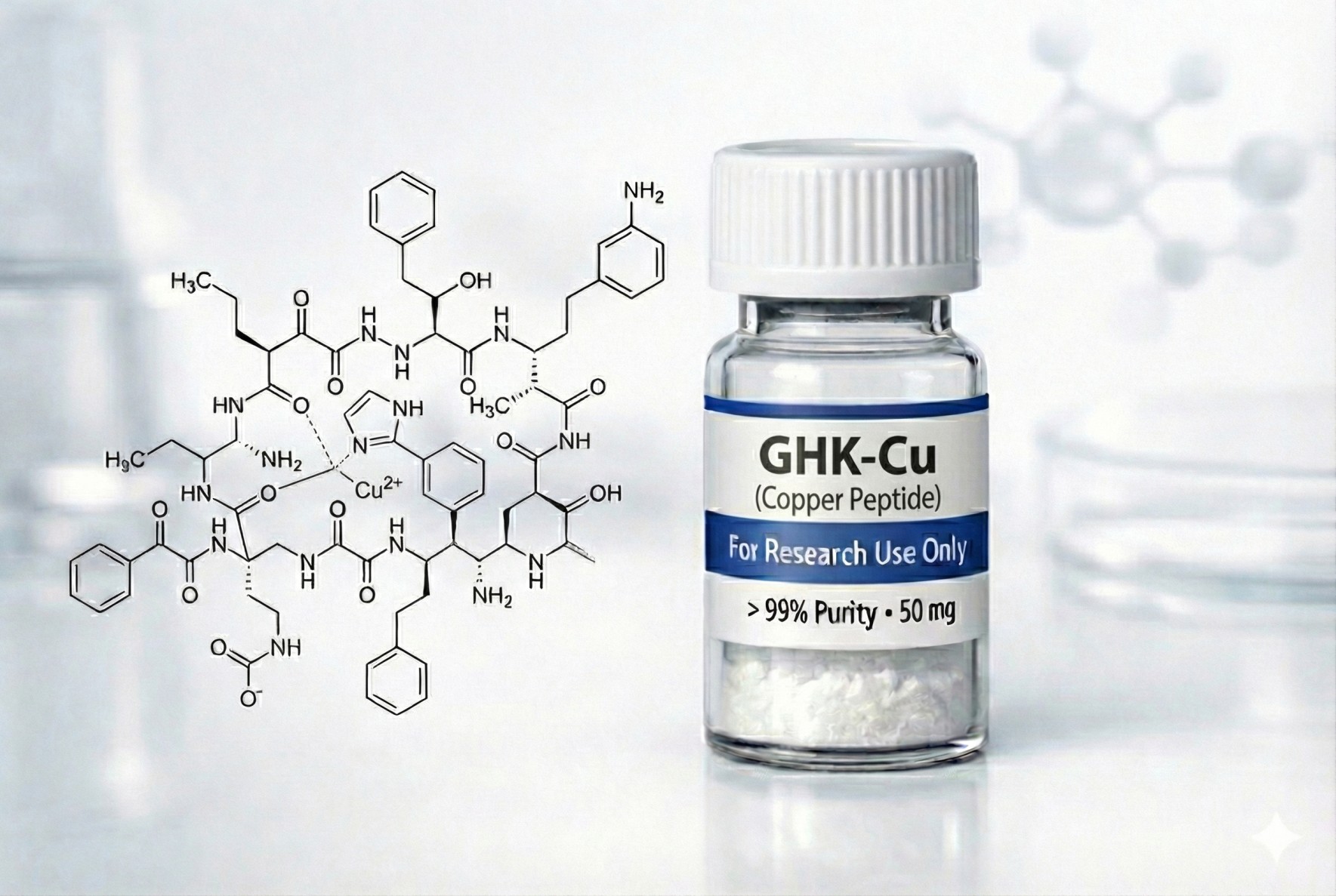
GHK-Cu is a naturally occurring tripeptide-copper(II) complex (Gly-His-Lys, molecular weight 340 Da) first isolated by Dr. Loren Pickart from human albumin as an activity causing old liver tissue to synthesize proteins characteristic of younger tissue ¹ ². The peptide binds copper(II) with extraordinarily high affinity (log₁₀ = 16.44, exceeding albumin at 16.2), forming a square-planar complex where Cu(II) coordinates with histidine’s imidazole nitrogen, glycine’s alpha-amino group, and the deprotonated peptide bond nitrogen ¹ ².
Natural Occurrence and Biological Role:
GHK-Cu exists endogenously in human plasma, saliva, and urine, with plasma levels declining from ~200 ng/mL at age 20 to ~80 ng/mL by age 60 ¹ ². The GHK sequence is embedded within type I collagen’s α2(I) chain and SPARC glycoprotein ¹ ². During tissue injury, matrix metalloproteinases (MMPs) degrade these extracellular matrix proteins, liberating GHK-Cu at wound sites where it functions as a “matrikine”—a biologically active ECM fragment signaling tissue damage and activating repair ¹ ².
Copper Binding Properties:
When copper is bound to GHK, its redox activity is suppressed, preventing copper-catalyzed oxidative damage while enabling intracellular copper delivery ¹ ². GHK’s binding affinity allows it to acquire copper from albumin and transport it to cells in a non-toxic, redox-silenced form ¹ ².
Regulatory Status:
FDA classifies GHK-Cu for topical/oral routes as Category 1 (Under Evaluation), permitting compounding use ⁸. Injectable GHK-Cu is Category 2 (Significant Safety Concerns), prohibiting injectable compounding ⁸. GHK-Cu has never been FDA-approved as a pharmaceutical drug but has been extensively used in cosmetic products since the 1980s ¹ ².
How It Works
Genome-Wide Gene Expression Modulation
GHK-Cu’s most remarkable property is unprecedented genome-wide regulatory activity affecting 4,000+ human genes (31.2% of the genome) ¹ ².
Scale and Pattern of Gene Modulation:
Using the Broad Institute’s Connectivity Map database, researchers found GHK affects 2,687 genes (upregulated) and 1,513 genes (suppressed), with changes ranging from 50% to over 1200% ¹ ². Rather than random modulation, GHK exhibits a consistent pattern: activating health-promoting genes (tissue regeneration, collagen synthesis, antioxidant defense, DNA repair, angiogenesis) while suppressing disease-associated genes (inflammation, fibrosis, cancer metastasis, NFκB activation) ¹ ². This led researchers to propose GHK “resets DNA back to a healthier state,” reversing pathological gene expression toward patterns characteristic of younger, healthier tissues ¹ ².
TGF-β and Integrin Pathway Activation
COPD Gene Signature Reversal:
Campbell et al.’s landmark 2012 study in Genome Medicine identified 127 genes significantly altered in COPD emphysema patients—inflammatory genes upregulated, tissue remodeling/repair genes (particularly TGF-β pathway) downregulated ⁶. Using Connectivity Map analysis, researchers identified GHK as the compound reversing this COPD gene signature and restoring TGF-β pathway activation ⁶.
Functional Restoration: Lung fibroblasts from COPD patients showed impaired collagen gel contraction and remodeling ⁶. GHK treatment restored these functions to levels comparable to fibroblasts from healthy ex-smokers, enabled collagen gel remodeling into fibrils, and elevated integrin β1 expression—effects comparable to TGF-β treatment ⁶. This established GHK improves tissue regeneration by restoring TGF-β and integrin signaling ⁶.
Collagen and Extracellular Matrix Regulation
Matrix Protein Synthesis:
Maquart, Borel, and colleagues (1980s-1990s) established GHK-Cu’s ECM effects at nanomolar concentrations (1-10 nM) ¹ ²:
- Stimulates type I collagen synthesis in fibroblasts
- Stimulates glycosaminoglycan synthesis (dermatan sulfate, chondroitin sulfate)
- Stimulates decorin production (proteoglycan important for collagen fibril assembly)
- Modulates synthesis and breakdown of collagen
MMP and TIMP Balance:
GHK regulates wound healing and skin remodeling by modulating matrix metalloproteinases (MMPs—ECM-degrading enzymes) and tissue inhibitors of metalloproteinases (TIMPs—MMP blockers) ¹ ². At 0.01 nM, GHK-Cu increased MMP1 and MMP2 gene expression while increasing TIMP1 at all concentrations, preventing both excessive protein accumulation and excessive proteolysis ¹ ².
Anti-Cancer Actions
Metastatic Colon Cancer Gene Suppression:
Hong et al. (2010) used Connectivity Map to identify molecules inhibiting metastatic colon cancer ²⁰. Of 1,309 bioactive molecules tested, only two effectively downregulated “metastatic” gene expression ²⁰:
- GHK (1 μM, non-toxic)
- Securinine (plant alkaloid, 18 μM)
GHK suppressed RNA production in 70% of 54 genes overexpressed in aggressive metastatic colon cancer, including “node molecules” (YWHAB, MAP3K5, LMNA, APP, GNAQ, F3, NFATC2, TGM2) regulating multiple biological functions ¹ ² ²⁰.
Antioxidant and DNA Repair
Potent Antioxidant Activity:
GHK completely blocked Cu(2+)-dependent LDL oxidation (100% protection vs. 20% by SOD1), inactivates toxic lipid peroxidation by-products (4-hydroxynonenal, acrolein, malondialdehyde, glyoxal), and reduced iron release from ferritin by 87% ¹ ².
DNA Repair Gene Activation:
GHK significantly increased DNA repair gene expression (47 genes stimulated ≥50%) ¹ ². Irradiated human fibroblasts (5000 rad) treated with GHK (10⁻⁹ M) showed much faster growth similar to non-irradiated controls, higher growth factor production, and restored replicative capacity despite DNA damage ¹ ².
Research Evidence
Human Clinical Trials—Skin Regeneration
Collagen Production Superiority (Abdulghani AA et al., 1998)
Placebo-controlled study comparing GHK-peptide cream to vitamin C, tretinoin, and control on thighs for one month in women age ~50 ¹:
- GHK-peptides: Significant collagen increases in 70% of women
- Vitamin C: Increases in 50%
- Retinoic acid: Increases in 40%
Facial Photoaging (Leyden J et al., 2002, N=71)
12-week placebo-controlled study; GHK-Cu cream twice daily ¹:
- Reduced skin laxity, improved elasticity
- Reduced fine lines and wrinkle depth
- Increased skin density and thickness
Comprehensive Facial with Histology (Finkley M et al., 2005, N=67)
12-week study in women ages 50-59 with histological biopsy analysis ¹:
- Reduced wrinkles and hyperpigmentation
- Increased skin density and thickness
- Strongly stimulated dermal keratinocyte proliferation (histologically confirmed)
Animal Wound Healing Studies
Species-Wide Efficacy:
Studies in rabbits, rats, dogs, and pigs demonstrated ¹ ²:
- 9-fold increased collagen synthesis (rat study)
- Accelerated wound closure and granulation tissue
- Enhanced angiogenesis
- Elevated antioxidant enzymes (glutathione, ascorbic acid, SOD)
- Reduced inflammatory cytokines (TNF-β, IL-6)
- Improved healing of diabetic and ischemic wounds
Lung Disease—COPD Gene Signature Reversal
Campbell JD et al., 2012 – Genome Medicine
Collaborative study (Boston University, University of Groningen, University of British Columbia, University of Pennsylvania) ⁶:
Gene Expression Analysis: Identified 127 genes significantly associated with emphysema severity; GHK identified as compound reversing COPD gene signature and restoring TGF-β pathway ⁶.
In Vitro Functional Validation: COPD patient lung fibroblasts showed impaired collagen gel contraction/remodeling ⁶. GHK treatment restored function to ex-smoker levels, enabled collagen remodeling, and elevated integrin β1 ⁶.
Significance: First demonstration GHK reverses a disease-associated gene signature and restores diseased human cell function ⁶.
Conditions Being Researched
Skin Aging and Photoaging
Clinical Status: Multiple published controlled trials (N=200+) demonstrate efficacy ¹.
Mechanisms: Collagen/elastin synthesis, MMP/TIMP balance, fibroblast activation (12.5-fold viability increase with LED), stem cell activation, 100% LDL oxidation protection, UV damage prevention ¹ ².
Evidence: 70% collagen production response vs. 50% (vitamin C) and 40% (retinoic acid); significant wrinkle reduction, improved elasticity, increased skin density ¹.
Wound Healing
Preclinical Status: Extensively studied across multiple species (rabbits, rats, dogs, pigs) ¹ ².
Mechanisms: 9-fold collagen synthesis increase, enhanced angiogenesis, elevated antioxidant enzymes, reduced inflammatory cytokines, improved diabetic/ischemic wound healing ¹ ².
Clinical Use: Mixed copper peptide complexes used in four human wound healing studies showed more rapid healing and reduced erythema vs. controls ¹.
Chronic Obstructive Pulmonary Disease (COPD)
Research Status: Gene expression reversal demonstrated in human lung tissue and fibroblasts ⁶.
Mechanisms: Reverses 127-gene emphysema signature, restores TGF-β pathway activation, normalizes tissue remodeling genes, restores fibroblast contractile function, elevates integrin β1 ⁶.
Evidence: Restored COPD fibroblast collagen gel contraction/remodeling to healthy ex-smoker levels ⁶.
Clinical Potential: No human clinical trials yet conducted, but gene signature reversal suggests therapeutic potential warranting investigation ⁶.
Acute Lung Injury
Preclinical Status: Mouse models demonstrate protective effects ².
Mechanisms: Suppressed inflammatory cell infiltration, increased SOD activity, decreased TNF-α and IL-6, blocked NFκB p65 and p38 MAPK activation ².
Metastatic Cancer
Research Status: Gene expression profiling and in vitro cancer cell studies ¹ ² ²⁰.
Mechanisms: Suppresses 70% of 54 genes overexpressed in aggressive metastatic colon cancer, reactivates apoptosis (caspase 3/7), selectively inhibits cancer cell growth while stimulating normal fibroblast growth ¹ ² ²⁰.
Evidence: Of 1,309 bioactive molecules tested, only GHK and securinine effectively reversed metastatic gene expression signature ²⁰. GHK-Cu combined with vitamin C strongly suppressed sarcoma-180 tumor growth in mice ¹.
Clinical Status: No human cancer trials; in vitro and gene expression data suggest potential warranting investigation.
Cardiovascular Disease
Research Status: Epidemiological correlation with fibrinogen; gene expression studies ¹ ².
Mechanisms: Suppresses IL-6 (main fibrinogen synthesis regulator), downregulates fibrinogen beta chain gene (-475%), reduces blood viscosity ¹ ².
Epidemiological Evidence:
- PROCAM Study (5,389 men, 10 years): Top third fibrinogen had 2.4-fold higher coronary events; top third fibrinogen + high LDL had 6.1-fold increased risk ¹
- Scottish Heart Health Study (10,359 subjects, 2 years): Fibrinogen was single most powerful CVD risk factor—more predictive than cholesterol ¹
Clinical Status: GHK was originally isolated as fibrinogen-suppressing activity; no cardiovascular clinical trials conducted.
Nerve Regeneration and Neuroprotection
Preclinical Status: Cell culture and animal studies ¹ ².
Mechanisms: Stimulates nerve outgrowth, increases nerve growth factor/NT-3/NT-4 production, accelerates nerve fiber regeneration, increases axon count and Schwann cell proliferation, upregulates OPRM1 (mu opioid receptor, +1294%) ¹ ².
Evidence: Rat severed nerve study showed GHK-Cu in collagen tubes accelerated regeneration and increased axon count ¹.
Behavioral Effects—Anxiety and Pain
Preclinical Status: Mouse and rat behavioral studies ¹ ².
Mechanisms: Upregulates anti-pain genes (OPRM1 +1294%, CCKAR +190%, CNR1 +172%), structural similarity to cimetidine (analgesic) ¹ ².
Evidence:
- Hot plate test: GHK 0.5 mg/kg reduced pain perception
- Rat maze test: GHK 0.5 μg/kg increased open area exploration, decreased immobility (anti-anxiety)
- Aggression test: GHK reduced attacks 5-fold
Relevance to Skin: Psychological stress delays epidermal barrier recovery and impairs immune function; reducing anxiety improves healing ¹ ².
DNA Repair and Radiation Recovery
Research Status: Gene expression studies and irradiated cell culture experiments ¹ ².
Mechanisms: Affects 84 DNA repair genes (47 stimulated ≥50%, 5 suppressed ≥50%), upregulates 10 caspase genes ¹ ².
Evidence: Irradiated human fibroblasts (5000 rad) treated with GHK (10⁻⁹ M) showed restored growth, higher growth factor production, and restored replicative capacity ¹ ².
Clinical Application: McCormack et al. (2001) found GHK-Cu restored fibroblast function in patients after anticancer radiation therapy ¹.
Anti-Aging via Ubiquitin Proteasome System
Research Status: Gene expression studies ¹ ².
Mechanisms: Strongly stimulates ubiquitin proteasome system (41 UPS genes increased +50% to +1056%, top gene USP29 +1056%) ¹ ².
Significance: UPS clears damaged proteins; function declines with aging. Enhanced proteasome activity removes accumulated damaged proteins, representing potential anti-aging mechanism ¹ ².
Current Status & Considerations
Regulatory and Commercial Status
FDA Classification: Category 1 (topical/oral) permits compounding; Category 2 (injectable) prohibits injectable compounding due to immunogenicity, aggregation, and peptide-related impurity concerns ⁸.
Commercial Use: Extensively used in cosmetic products since 1980s; thousands of topical formulations available; compounded topical/oral medications permitted; no FDA drug approval ¹ ².
Evidence Summary
Human Clinical Evidence (Topical): 7+ placebo-controlled trials (N=200+) with objective measurements (histological biopsy analysis, collagen quantification, wrinkle measurements) demonstrate consistent efficacy ¹.
Safety Record: 40+ years topical use without reported adverse effects; “GHK is very safe and no issues have ever arisen during its use as a skin cosmetic or in human wound healing studies” ¹ ².
Human Injectable Evidence: Zero published controlled trials; FDA Category 2 restriction reflects absence of safety data ⁸.
Research Gaps and Future Directions
Clinical Trials Needed:
- COPD/emphysema: Gene reversal demonstrated but no therapeutic trials
- Metastatic cancer prevention: Gene suppression shown but no human cancer trials
- Cardiovascular disease: Fibrinogen suppression mechanism established but no CVD outcome trials
- Nerve regeneration: Preclinical nerve outgrowth demonstrated but no neuropathy trials
- Systemic wound healing: Animal efficacy across species but limited human data
Mechanistic Questions:
- Long-term effects of sustained gene expression modulation (31.2% of genome)
- Optimal dosing strategies for various conditions
- Route-specific efficacy (topical vs. oral vs. injectable)
- Tissue-specific gene expression patterns
- Interaction with existing medications
Translation Challenges:
- Moving from gene expression data to clinical outcomes
- Developing pharmaceutical-grade formulations for systemic use
- Establishing safety profile for injectable/systemic administration
- Determining which conditions benefit most from GHK-Cu therapy
Footnotes
- Pickart L, Margolina A. GHK Peptide as a Natural Modulator of Multiple Cellular Pathways in Skin Regeneration. Biomed Res Int. 2015;2015:648108. doi:10.1155/2015/648108. PMID: 26221601.
- Pickart L, Margolina A. Regenerative and Protective Actions of the GHK-Cu Peptide in the Light of the New Gene Data. Int J Mol Sci. 2018;19(7):1987. doi:10.3390/ijms19071987. PMID: 29986520.
- Campbell JD, McDonough JE, Zeskind JE, et al. A gene expression signature of emphysema-related lung destruction and its reversal by the tripeptide GHK. Genome Med. 2012;4(8):67. doi:10.1186/gm367. PMID: 22937864.
- FDA. Certain Bulk Drug Substances Used in Compounding May Present Significant Safety Risks. Updated August 6, 2025.
- Hong Y, Downey T, Eu KW, et al. A ‘metastasis-prone’ signature for early-stage mRNA-profiling-based classification of colorectal cancer. Clin Exp Metastasis. 2010;27(2):83-90. doi:10.1007/s10585-010-9305-4. PMID: 19816040.
References
Comprehensive Reviews
Pickart L, Margolina A. GHK Peptide as a Natural Modulator of Multiple Cellular Pathways in Skin Regeneration. Biomed Res Int. 2015;2015:648108.
Pickart L, Margolina A. Regenerative and Protective Actions of the GHK-Cu Peptide in the Light of the New Gene Data. Int J Mol Sci. 2018;19(7):1987.
Landmark Studies
Campbell JD, McDonough JE, Zeskind JE, et al. A gene expression signature of emphysema-related lung destruction and its reversal by the tripeptide GHK. Genome Med. 2012;4(8):67.
Hong Y, Downey T, Eu KW, et al. A ‘metastasis-prone’ signature for early-stage mRNA-profiling-based classification of colorectal cancer. Clin Exp Metastasis. 2010;27(2):83-90.
Regulatory
FDA. Certain Bulk Drug Substances Used in Compounding May Present Significant Safety Risks.
Disclaimer
This content is for educational and research purposes only. GHK-Cu for topical/oral routes is FDA Category 1 (Under Evaluation), permitting compounding use. Injectable GHK-Cu is FDA Category 2, prohibited from compounding due to safety concerns. While GHK-Cu has been extensively used in cosmetic products for 40+ years and studied in multiple clinical trials for topical skin applications, it has never been FDA-approved as a pharmaceutical drug. Systemic therapeutic applications (COPD, cancer, cardiovascular disease) are based on preclinical research and gene expression studies without human clinical trials. All products are intended strictly for laboratory research and development purposes only.