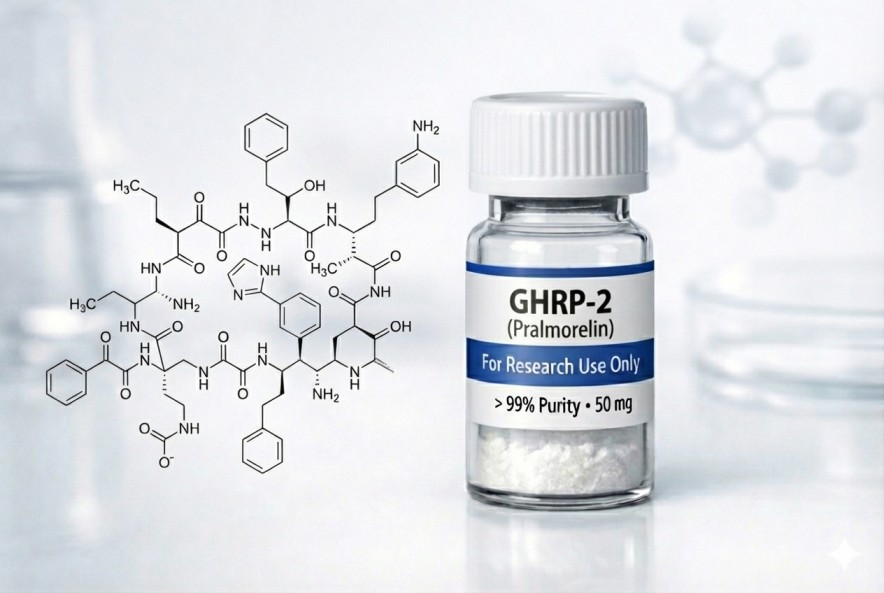
 GHRP-2 (Pralmorelin)
$175.00

Review article author: University of Maryland Center of Excellence in Regulatory Science and Innovation (M-CERSI) (2021)
Primary clinical studies: Laferrère B et al. (2005), Sigalos JT et al. (2017)
Review article author: Sigalos JT & Pastuszak AW (2017)
GHRP-2 (growth hormone-releasing peptide-2), also known as pralmorelin, is a synthetic hexapeptide that stimulates growth hormone (GH) release through the ghrelin receptor (GHS-R) pathway.¹ ² Developed as a more potent successor to GHRP-6, GHRP-2 demonstrates 2-3 times greater GH-releasing activity than its predecessor in both animal and human studies.¹ ² A comprehensive 2021 systematic review conducted for the FDA identified only 4 human clinical trials meeting inclusion criteria, examining GHRP-2 for short stature, anorexia nervosa, and wasting syndrome—with no trials evaluating the body composition and anti-aging applications that currently drive widespread off-label use.¹ Subject matter expert interviews revealed that GHRP-2 is primarily used as “lifestyle medication” for patients seeking physical appearance improvements, often prescribed in combination with other GH secretagogues (particularly GHRP-6 and sermorelin) based on synergistic mechanisms rather than clinical trial evidence.¹ As of 2026, GHRP-2 remains FDA-unapproved for any indication, with clinical development apparently discontinued by pharmaceutical manufacturers despite demonstrated GH-releasing activity.¹ ²
$175.00
GHRP-2 (pralmorelin) is a synthetic hexapeptide belonging to the growth hormone-releasing peptide class of GH secretagogues.¹ ² Developed through systematic modification of the GHRP-1 and GHRP-6 scaffolds, GHRP-2 was designed to optimize GH-releasing potency while improving pharmacokinetic properties.¹ ² The compound acts as a ghrelin mimetic, binding to and activating the growth hormone secretagogue receptor (GHS-R, also known as the ghrelin receptor) expressed in both the hypothalamus and anterior pituitary somatotroph cells.¹ ²
GHRP-2 demonstrates 2-3 times greater GH-releasing activity compared to GHRP-6 and GHRP-1 in both rats and humans, representing a significant improvement in potency within the GHRP class.² Despite this enhanced activity, GHRP-2 retains the short half-life and limited oral bioavailability characteristic of peptide-based GH secretagogues, necessitating parenteral (injectable) administration for clinical use.¹ ²
The compound received significant pharmaceutical development attention in the late 1990s and early 2000s. Wyeth (now part of Pfizer) advanced GHRP-2 through Phase II clinical trials in the United States for GH deficiency, while Kaken Pharmaceutical pursued development in Japan for short stature (pituitary dwarfism) under the designation KP-102 LN.² However, both development programs appear to have been discontinued—Wyeth’s development ceased without published explanation, and Kaken’s planned 2009 launch never materialized.² As of 2026, GHRP-2 is not approved for any indication in any country surveyed by the University of Maryland review.¹
The mechanism of action involves direct activation of GHS-R on pituitary somatotrophs, increasing the number of cells releasing GH and enhancing pulse amplitude.¹ ² This mechanism is independent of and complementary to GHRH, which acts through separate GHRH receptors.¹ ² When GHRP-2 and GHRH analogs (such as sermorelin or CJC-1295) are coadministered, they produce synergistic GH release substantially exceeding either compound alone—a property that drives common combination protocols despite absence of controlled trials validating these regimens.¹ ²
Beyond GH stimulation, GHRP-2 demonstrates appetite-stimulating effects mediated through ghrelin receptor activation.³ ⁴ Clinical studies demonstrated that acute GHRP-2 administration increased ad libitum food intake by 10-34% in a dose-dependent manner in both lean and obese subjects, accompanied by increased hunger ratings.³ ⁴ This dual effect—GH release plus appetite stimulation—led to investigation of GHRP-2 for conditions involving both growth impairment and inadequate caloric intake (anorexia nervosa, wasting syndromes).¹
Mechanism of Action
GHRP-2 operates through the ghrelin receptor (GHS-R) signaling pathway to stimulate GH release and regulate appetite:¹ ² ³
Ghrelin Receptor Activation: GHRP-2 binds to and activates GHS-R1a, a G-protein coupled receptor expressed on hypothalamic neurons and pituitary somatotroph cells.¹ ² Upon ligand binding, the receptor activates Gq proteins, leading to phospholipase C (PLC) activation, inositol trisphosphate (IP₃) production, and intracellular calcium mobilization.² This calcium flux triggers immediate GH secretion from stored granules while activating protein kinase C (PKC) and other signaling cascades that enhance GH gene transcription.²
Amplification of GH Pulse Amplitude: Unlike GHRH which primarily regulates the amount of GH secreted per pulse, GHRPs like GHRP-2 increase the number of somatotrophs participating in each secretory event, effectively amplifying pulse amplitude.¹ ² This mechanism is independent of GHRH and does not require intact GHRH signaling, though GHRH receptor presence potentiates GHRP-2’s stimulus.¹
Somatostatin Suppression: Evidence suggests GHRPs partially work by suppressing somatostatin, the hypothalamic peptide that tonically inhibits GH release.¹ By reducing this inhibitory tone, GHRP-2 permits more robust GH secretion in response to stimulatory signals.¹
Potency and Efficacy: GHRP-2 demonstrates 2-3 fold greater GH-releasing potency compared to GHRP-6 in both in vitro and in vivo studies, requiring lower doses to achieve equivalent GH elevation.² Despite improved potency, GHRP-2 retains relatively short duration of action, with GH levels returning toward baseline within 2-4 hours following single administration.¹
Synergy with GHRH Analogs: When GHRP-2 is coadministered with GHRH or GHRH analogs (sermorelin, CJC-1295), the combination produces synergistic GH release substantially exceeding the additive effects of either compound alone.¹ ² This synergy results from complementary mechanisms—GHRH increases GH synthesis and secretion per somatotroph, while GHRP-2 increases the number of cells releasing GH and suppresses somatostatin inhibition.¹ Subject matter experts interviewed for the FDA review consistently cited this synergy as rationale for combination protocols, though no controlled human trials have validated optimal combinations or dosing.¹
Appetite Stimulation: As a ghrelin mimetic, GHRP-2 activates GHS-R in hypothalamic appetite-regulating centers, stimulating hunger and increasing food intake.³ ⁴ The Laferrère studies demonstrated that subcutaneous GHRP-2 infusion increased ad libitum food intake by 10.2% at low dose (0.1 µg/kg/hr) and 33.5% at high dose (1 µg/kg/hr) compared to placebo, with effects occurring in both lean and obese subjects.³ ⁴ Subjects reported greater appetite ratings before meals but similar fullness after eating, suggesting GHRP-2 increases meal initiation drive without affecting satiety signals.³ ⁴
Pharmacokinetics: GHRP-2 exhibits limited oral bioavailability due to peptide structure susceptibility to gastrointestinal degradation, requiring parenteral administration (subcutaneous or intravenous).¹ ² Following injection, peak GH responses occur within 30-60 minutes, with GH levels declining toward baseline by 2-4 hours.¹ The relatively short duration necessitates multiple daily administrations (typically 2-3 times daily) to maintain elevated GH secretory capacity.¹ Subject matter experts noted that this dosing frequency makes in-office administration impractical, requiring patient self-administration at home.¹
Physiological Effects
The downstream effects of GH elevation include:¹ ²
Comprehensive Systematic Review
University of Maryland Center of Excellence in Regulatory Science and Innovation (M-CERSI), 2021 – Growth hormone-releasing peptide-2: Summary Report for FDA 503B Bulks List Evaluation
*Comprehensive scoping review examining clinical use of GHRP-2 to assist FDA in evaluating inclusion on the 503B Bulks List for compounding.*¹
**Systematic Literature Review Methodology:**¹
**Results:**¹
**Indications Studied:**¹
Key Finding: GHRP-2 is not available as an FDA-approved product in any dosage form or route. GHRP-2 is not available in any of the 13 foreign national registries searched (Canada, EU, UK, Ireland, Belgium, Latvia, Australia, New Zealand, Saudi Arabia, Abu Dhabi, Hong Kong, Namibia).¹
**Subject Matter Expert Interviews (N=4 SMEs):**¹
**Survey Results:**¹
**Conclusion:**¹
“In the 4 studies included from the literature review, GHRP2 was used for treatment of short stature, and to stimulate appetite and increase body weight and muscle mass in patients with anorexia nervosa or critical illness… Several SMEs stated that there was limited outcomes-based human research on the clinical use of GH and GH secretagogues, making it difficult to know the ideal combination and dose of medication to use, and the effects of long-term use.”
Significance: This FDA-commissioned review demonstrates a profound evidence gap for GHRP-2—only 4 small studies examining narrow indications (short stature, eating disorders, critical illness), zero studies examining the body composition and anti-aging applications driving current off-label use, and complete absence of evidence for combination protocols despite widespread practice.¹
Appetite Stimulation Studies
Laferrère B et al., 2005 – Growth Hormone Releasing Peptide-2 (GHRP-2), Like Ghrelin, Increases Food Intake in Healthy Men
Design: Randomized, double-blind, placebo-controlled crossover study in 7 lean healthy men examining acute effects of GHRP-2 on appetite and food intake.³
**Study Protocol:**³
*Results:*³
Follow-up Study: Obesity and Dose-Response
Design: Randomized, double-blind, placebo-controlled study in 19 subjects (10 lean, 9 obese) examining dose-dependent effects of GHRP-2.⁴
*Results:*⁴
Significance: These studies establish that GHRP-2’s appetite-stimulating effects occur acutely in humans, are dose-dependent, and persist in obesity.³ ⁴ This dual action (GH release + appetite stimulation) distinguishes GHRP-2 from GHRH analogs and suggests potential applications in conditions requiring both anabolic support and increased caloric intake.³ ⁴
Combination Therapy Study
Sigalos JT et al., 2017 – Growth Hormone Secretagogue Treatment in Hypogonadal Men Raises Serum Insulin-Like Growth Factor-1 Levels
Design: Retrospective review of 105 hypogonadal men on testosterone therapy who were prescribed GHRP-2 100 µg / GHRP-6 100 µg / sermorelin 100 µg subcutaneously three times daily.⁵
**Study Population:**⁵
*Results:*⁵
*Limitations:*⁵
Significance: This represents the only published study examining the GHRP-2 / GHRP-6 / sermorelin combination frequently mentioned by SMEs in the University of Maryland review.¹ ⁵ While it demonstrates biomarker elevation (IGF-I), the study provides no evidence for functional benefits and suffers from significant methodological limitations.⁵
Broader GH Secretagogue Context
Sigalos JT & Pastuszak AW, 2018 – The Safety and Efficacy of Growth Hormone Secretagogues
*Systematic review of GH secretagogues providing context for GHRP-2 within the broader class.*²
**Key Points:**²
Research Status
As of January 2026, GHRP-2 (pralmorelin) is not FDA-approved for any medical indication and is not approved in any of the 13 countries/regions surveyed by the University of Maryland review.¹ Pharmaceutical development by both Wyeth (US) and Kaken (Japan) was discontinued without published explanation, suggesting either commercial challenges, insufficient efficacy in clinical trials, or safety concerns that halted advancement.¹ ²
The FDA-commissioned systematic review identified only 4 human clinical trials meeting inclusion criteria—examining short stature, anorexia nervosa, and wasting syndrome—with zero trials evaluating body composition or anti-aging applications that currently drive off-label use.¹ The stark finding of zero survey respondents from professional medical associations suggests GHRP-2 use is largely confined to “lifestyle medicine” practices outside mainstream medical specialties.¹
Subject matter expert interviews revealed that GHRP-2 is rarely used as monotherapy, more commonly prescribed in combination with GHRP-6 and/or sermorelin based on theoretical synergy rather than clinical trial evidence.¹ SMEs acknowledged “limited literature” on optimal combinations, dosing, and long-term outcomes, with prescribing decisions based on pharmacological reasoning, anecdotal experience, and patient demand rather than evidence-based guidelines.¹
Potential Research Applications
Growth Hormone Deficiency: GHRP-2 was investigated for GH deficiency in pharmaceutical development programs that were subsequently discontinued.¹ ² While preclinical and early clinical data demonstrated GH-releasing activity, progression to approval suggests either inadequate efficacy, safety concerns, or commercial challenges.¹ For documented GH deficiency, FDA-approved recombinant GH remains the evidence-based standard of care.²
Short Stature in Children: The University of Maryland review identified studies using intranasal GHRP-2 (10-45 µg/kg/day) for 6-24 months in children with idiopathic short stature or GH insufficiency.¹ Results suggested “modest” increases in growth velocity, but discontinuation of pharmaceutical development by Kaken indicates outcomes were insufficient for commercial viability or regulatory approval.¹
Appetite Stimulation and Wasting: GHRP-2’s dual effects—GH stimulation and appetite increase—created interest for conditions involving both growth impairment and inadequate caloric intake.¹ ³ ⁴ Studies in anorexia nervosa (N=1) and critical illness wasting (N=14) showed some promise, but extremely small sample sizes and lack of follow-up research suggest limited enthusiasm for these applications.¹
Body Composition Optimization: SME interviews revealed this as the primary current application—prescribed to patients (often already on testosterone therapy) seeking improvements in lean mass and fat loss.¹ However, the University of Maryland review found zero clinical trials examining GHRP-2 for body composition in healthy adults or as enhancement therapy.¹ The single study in hypogonadal men showed IGF-I elevation but measured no functional outcomes.⁵
Combination Protocols: SME interviews consistently cited combination therapy (GHRP-2 + GHRP-6 + sermorelin) as “trending” based on synergistic GH release mechanisms.¹ The Sigalos 2017 study examined this specific combination in 14 patients, demonstrating IGF-I elevation but no functional benefits.⁵ No controlled trials have systematically evaluated optimal combinations, doses, or schedules for any indication.¹
Safety Profile Summary
The University of Maryland review identified limited safety data:¹
**Short-term tolerance (4 studies, N=46):**¹
**Known effects:**³ ⁴
**Critical Safety Gaps:**¹ ²
Important Considerations
Profound Evidence Gap for Current Use: The University of Maryland review reveals perhaps the starkest evidence-practice disconnect in the peptide field.¹ Zero of 4 included studies examined body composition or anti-aging applications, yet SMEs describe these as primary current uses.¹ All prescribing for these indications occurs without supporting clinical trial evidence.¹
Discontinued Pharmaceutical Development: Both Wyeth and Kaken advanced GHRP-2 through Phase II trials but discontinued development without published explanation.¹ ² This strongly suggests that either efficacy was insufficient, safety concerns emerged, or commercial viability was inadequate—important context rarely discussed in “lifestyle medicine” promotion of GHRP-2.¹
“Lifestyle Medicine” Context: SME interviews revealed GHRP-2 is prescribed primarily as “patient demand-based medicine” for physical appearance improvements rather than medical necessity.¹ Prescribing occurs in specialized practices (often urology, naturopathy, anti-aging clinics) rather than mainstream endocrinology, explaining zero survey responses from professional medical associations.¹
Combination Protocols Lack Evidence: Despite widespread use of GHRP-2 / GHRP-6 / sermorelin combinations and SME enthusiasm for “synergistic” effects, only one small retrospective study examined this combination—finding IGF-I elevation but no functional outcomes.¹ ⁵ All combination rationale derives from pharmacological theory, not clinical efficacy trials.¹
Rarely Used as Monotherapy: SMEs indicated GHRP-2 is more commonly prescribed in combination with other GH secretagogues than as single-agent therapy.¹ This practice complicates attribution of effects or adverse events to specific components and increases complexity, cost, and injection burden.¹
Dosing Based on Anecdote: SMEs acknowledged “limited literature” on optimal dosing, stating patients are started on low doses and titrated based on tolerance and desired outcomes rather than evidence-based protocols.¹ Typical dosing (100-500 µg/day subcutaneously, 2-3 times daily) derives from clinical experience rather than dose-finding trials.¹
Multiple Daily Injections Required: GHRP-2’s short duration necessitates 2-3 daily subcutaneous injections to maintain GH secretory capacity.¹ This creates substantial compliance burden compared to weekly alternatives (CJC-1295 with DAC) and makes in-office administration impractical, requiring patient self-administration.¹
Appetite Stimulation May Be Undesired: For applications focused on fat loss, GHRP-2’s appetite-stimulating effects (10-34% increases in food intake) may be counterproductive.³ ⁴ Other GH secretagogues without appetite effects (ipamorelin, CJC-1295, sermorelin alone) may be preferable for body composition applications.²
Product Quality Variability: As an unapproved compound available only through research suppliers and compounding pharmacies, GHRP-2 product quality, purity, and dosage accuracy vary substantially.¹ The University of Maryland review noted that even 503B outsourcing facilities face challenges with GHRP-2 production.¹ No regulatory oversight ensures product consistency or safety.
No Approval Anywhere: Unlike some peptides approved in select countries, GHRP-2 is not approved in any of 13 countries/regions surveyed—United States, Canada, EU, UK, Ireland, Belgium, Latvia, Australia, New Zealand, Saudi Arabia, Abu Dhabi, Hong Kong, or Namibia.¹ This global absence of approval is notable and suggestive of fundamental limitations.
Regulatory and Legal Status: GHRP-2 is not FDA-approved for any indication and is prohibited by WADA for competitive athletes.¹ Use outside approved clinical trials may carry legal and professional consequences. Prescribing occurs in regulatory gray zones without established clinical guidelines.¹
Alternative Approaches Exist: For documented GH deficiency, FDA-approved recombinant GH provides evidence-based treatment.² For enhancement applications, no peptide-based secretagogue has sufficient evidence to recommend over established interventions (resistance training, adequate protein, sleep optimization) with proven efficacy and safety.²
Comprehensive Systematic Review
University of Maryland Center of Excellence in Regulatory Science and Innovation (M-CERSI). Growth hormone-releasing peptide-2: Summary Report prepared for Food and Drug Administration, Clinical use of bulk drug substances nominated for inclusion on the 503B Bulks List. Grant number: 5U01FD005946. January 2021.
Broader GH Secretagogue Reviews
Sigalos JT, Pastuszak AW. The Safety and Efficacy of Growth Hormone Secretagogues. Sexual Medicine Reviews. 2018;6(1):45-53. doi:10.1016/j.sxmr.2017.02.004. PMID: 28400207.
Primary Clinical Studies
Laferrère B, Abraham C, Russell CD, Bowers CY. Growth hormone releasing peptide-2 (GHRP-2), like ghrelin, increases food intake in healthy men. Journal of Clinical Endocrinology & Metabolism. 2005;90(2):611-614. doi:10.1210/jc.2004-1719. PMID: 15699539.
Laferrère B, Hart AB, Bowers CY. Obese subjects respond to the stimulatory effect of the ghrelin agonist growth hormone-releasing peptide-2 on food intake. Obesity. 2006;14(6):1056-1063. doi:10.1038/oby.2006.121.
Sigalos JT, Pastuszak AW, Allison A, et al. Growth hormone secretagogue treatment in hypogonadal men raises serum insulin-like growth factor-1 levels. American Journal of Men’s Health. 2017;11(6):1752-1758. doi:10.1177/1557988317723422.
Additional Studies Identified in University of Maryland Review
Pihoker C, Badger TM, Reynolds GA, Bowers CY. Treatment effects of intranasal growth hormone releasing peptide-2 in children with short stature. Journal of Endocrinology. 1997;155(1):79-86.
Tuilpakov AN, Bulatov AA, Peterkova VA, et al. Growth hormone (GH) responses to GH-releasing peptide-2 and GH-releasing hormone in children with various forms of short stature. Journal of Clinical Endocrinology & Metabolism. 1995;80(7):2239-2244.
Haruta I, Fuku Y, Kinoshita K, et al. One-year intranasal application of growth hormone releasing peptide-2 improves body weight and hypoglycemia in a severely emaciated anorexia nervosa patient. Journal of Cachexia, Sarcopenia and Muscle. 2015;6(3):237-241.
Van den Berghe G, Baxter RC, Weekers F, et al. A paradoxical gender dissociation within the growth hormone/insulin-like growth factor I axis during protracted critical illness. Journal of Clinical Endocrinology & Metabolism. 1999;84(1):183-191.
This content is for educational and research purposes only and does not constitute medical advice. GHRP-2 is not FDA-approved for any medical indication and is not approved in any country surveyed by comprehensive regulatory review. A 2021 FDA-commissioned systematic review identified only 4 small clinical trials examining narrow indications (short stature, eating disorders, critical illness), with zero trials evaluating body composition or anti-aging applications that currently drive off-label use. Pharmaceutical development programs by major companies were discontinued without published explanation. Current evidence does not support efficacy for applications driving widespread use. All products are intended strictly for laboratory research and development purposes only.
Javelin Sciences Adds the World’s First Topical KLOW80 Peptide Formula to Research Offerings Knoxville News Sentinel
Javelin Sciences Adds the World’s First Topical KLOW80 Peptide Formula to Research Offerings Columbia Daily Tribune
Fungal Peptide Boosts Intestinal Repair in Mice Bioengineer.org
Added to cart
Check out our shop to see what's available
GHRP-2 (Pralmorelin)