
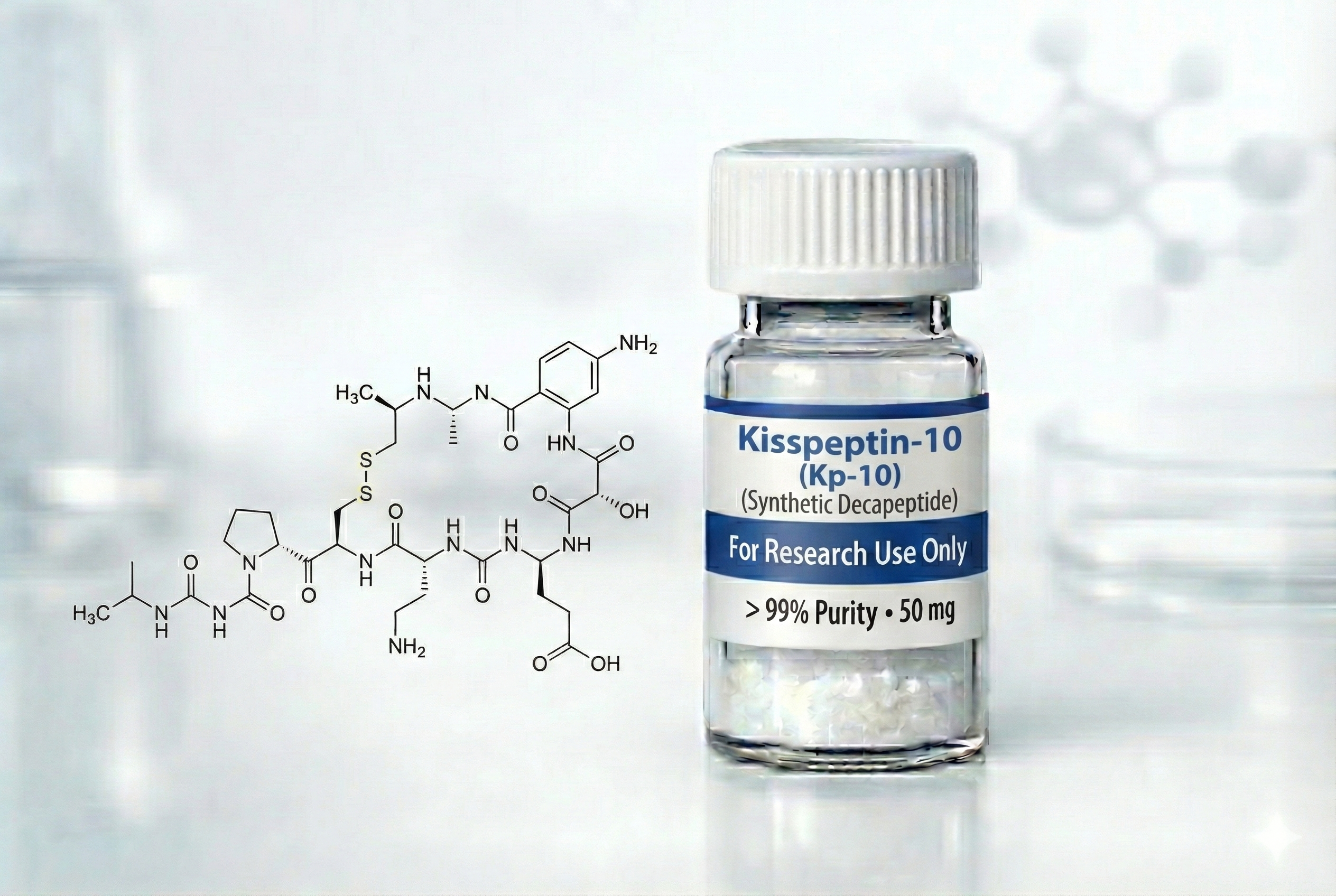
Description
Kisspeptin-10 is the C-terminal decapeptide fragment of the larger Kisspeptin-54 protein, retaining the core biological activity required to bind and activate the kisspeptin receptor (KISS1R or GPR54).⁸
Structure and Stability:
- Sequence: Tyr-Asn-Trp-Asn-Ser-Phe-Gly-Leu-Arg-Phe-NH2.⁹
- Active Core: It represents the minimal sequence necessary for full receptor activation.
- Half-Life: A major limitation is its metabolic instability. In humans, Kisspeptin-10 has a half-life of approximately 4 minutes, rapidly degraded by serum proteases.¹⁰ This contrasts with Kisspeptin-54, which lasts significantly longer, though Kisspeptin-10 is often preferred in research for studying acute, pulsatile hormonal responses.
Routes of Administration:
- Subcutaneous Injection: The most common method for research purposes. Due to the short half-life, users often employ frequent dosing schedules.
- Intravenous Infusion: Used primarily in clinical trials (like the George et al. study) to maintain stable plasma levels.³
- Intranasal: Investigational formulations exist but bioavailability is generally lower than injection.¹¹
Regulatory Status:
- FDA Status: Not FDA-approved for any medical condition.
- Compounding Crackdown: On October 29, 2024, the FDA Pharmacy Compounding Advisory Committee (PCAC) voted 11-0 to exclude Kisspeptin-10 from the 503A Bulks List.⁶ This effectively prohibits compounding pharmacies from legally creating Kisspeptin-10 prescriptions, pushing the market entirely toward unregulated “research chemical” vendors.
Reviews
There are no reviews yet.