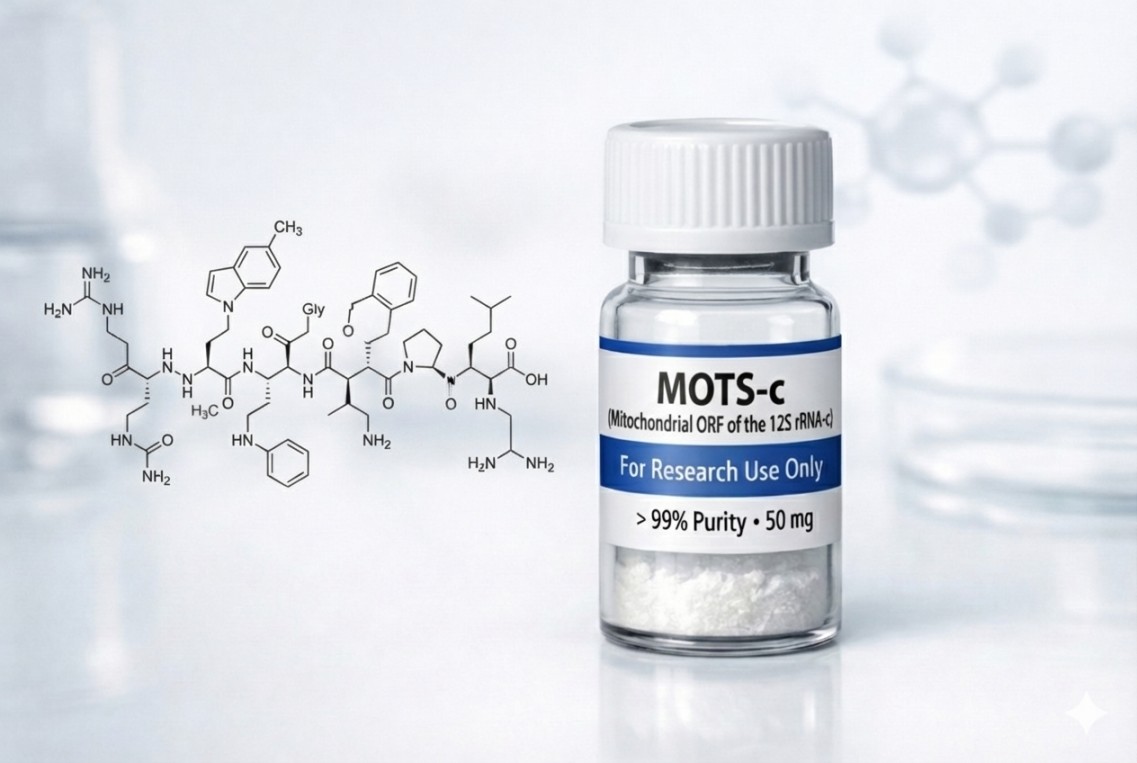
MOTS-c (Mitochondrial ORF of the 12S rRNA-c)

MOTS-c is a 16-amino acid mitochondrial-derived peptide encoded in the mitochondrial 12S rRNA gene that regulates metabolic homeostasis and cellular stress responses.¹ ² As a novel class of signaling molecule that bridges mitochondrial and nuclear genomes, MOTS-c targets skeletal muscle to enhance glucose metabolism, improve insulin sensitivity, and promote physical performance.¹ ³ Research demonstrates that exercise induces endogenous MOTS-c expression, with levels increasing 11.9-fold in skeletal muscle and 1.5-fold in circulation, positioning this peptide as a key mediator of exercise-related metabolic benefits and healthy aging.³

$285.00

- +

Description:

MOTS-c (Mitochondrial Open reading frame of the 12S rRNA-c) represents a paradigm shift in understanding mitochondrial function—revealing that mitochondria are not merely cellular powerplants but active endocrine organs encoding bioactive peptides that regulate systemic metabolism.¹ ⁴ This 16-amino acid peptide is encoded by a small open reading frame (sORF) within the mitochondrial 12S ribosomal RNA gene, a region previously considered non-coding.¹

The MOTS-c sequence is highly conserved across 14 mammalian species, particularly the first 11 N-terminal residues, suggesting evolutionary pressure to maintain this regulatory function.¹ ⁴ Unlike mitochondrially-encoded proteins that are translated within mitochondria using the mitochondrial genetic code, MOTS-c utilizes the standard genetic code and is translated in the cytoplasm after its transcript is exported from mitochondria.⁴

Under resting conditions, MOTS-c localizes primarily to mitochondria and cytoplasm, but during metabolic stress, it translocates to the nucleus in an AMPK-dependent manner.⁵ Once in the nucleus, MOTS-c binds to antioxidant response element (ARE)-regulated transcription factors, inducing expression of stress-response genes and restoring cellular homeostasis.⁵ This unique retrograde signaling pathway—from mitochondrial DNA to nuclear gene regulation—establishes MOTS-c as a critical mediator of mitochondrial-nuclear communication.

Circulating MOTS-c levels decline with age in both humans and mice, with young individuals showing 11-21% higher blood levels than middle-aged and elderly populations.⁴ ⁶ This age-dependent decline correlates with increased insulin resistance, reduced physical capacity, and metabolic dysfunction—all of which are reversed by exogenous MOTS-c administration in preclinical models.¹ ³ ⁴


How It Works


Mechanism of Action

MOTS-c regulates metabolism through multiple interconnected pathways:¹ ³ ⁴ ⁵

Folate-Purine-AMPK Pathway Activation: The primary metabolic target of MOTS-c is the folate cycle and tethered de novo purine biosynthesis pathway.¹ Treatment with MOTS-c decreases 5-methyltetrahydrofolate (5Me-THF) and methionine levels while increasing homocysteine, indicating folate cycle inhibition.¹ ⁴ This metabolic perturbation activates AMP-activated protein kinase (AMPK), the master regulator of cellular energy homeostasis.¹ AMPK activation shifts metabolism from anabolic to catabolic pathways, enhancing glucose uptake, fatty acid oxidation, and mitochondrial biogenesis.

Nuclear Translocation and Transcriptional Regulation: During metabolic stress (glucose restriction, oxidative stress, serum deprivation), MOTS-c translocates from the cytoplasm to the nucleus through an AMPK-dependent mechanism requiring hydrophobic residues.⁵ Nuclear MOTS-c binds to ARE-responsive transcription factors, inducing expression of genes involved in:⁵

  • Antioxidant defense (NRF2 pathway activation)
  • Heat shock response and proteostasis
  • Mitochondrial biogenesis and function
  • Glucose and lipid metabolism

This nuclear function allows MOTS-c to coordinate cellular stress responses and metabolic adaptation across both genomes.⁵

Skeletal Muscle as Primary Target: Approximately 70% of glucose disposal occurs in skeletal muscle, making it the critical tissue for insulin sensitivity and glucose homeostasis.¹ ⁴ MOTS-c treatment activates the Akt pathway in skeletal muscle, enhancing insulin-stimulated glucose uptake independently of changes in food intake.¹ In aged mice, 7-day MOTS-c treatment completely restored insulin sensitivity in soleus muscle to levels comparable with young mice.¹

Mitochondrial Biogenesis and Dynamics: MOTS-c upregulates genes related to mitochondrial biogenesis (PGC-1α, NRF1), mitochondria-encoded genes (MT-ND1, MT-CO1), and oxidative phosphorylation complexes.⁴ ⁷ This results in increased mitochondrial number, enhanced cristae formation, and improved respiratory capacity.⁴ Additionally, MOTS-c promotes mitochondrial fusion (Mfn1, Mfn2 upregulation) and mitophagy (PINK1, PARK2, ATG7 activation), optimizing mitochondrial quality control.⁴

Exercise-Mimetic Properties: Exercise induces endogenous MOTS-c expression in skeletal muscle (11.9-fold increase) and circulation (1.5-fold increase), with levels remaining elevated for 4 hours post-exercise.³ Exogenous MOTS-c administration recapitulates many exercise benefits, including enhanced physical performance, improved metabolic flexibility, and activation of exercise-responsive gene networks.³ This positions MOTS-c as a potential “exercise mimetic” that could benefit individuals with limited mobility.³ ⁴

Physiological Effects

Physical Performance Enhancement: MOTS-c treatment significantly improves treadmill running performance in young (2-month), middle-aged (12-month), and old (22-month) mice.³ Old mice treated with MOTS-c ran twice as long and 2.16-fold farther than untreated controls, with 17% reaching the highest speed stage compared to 0% in controls.³

Metabolic Homeostasis: Chronic MOTS-c treatment prevents age-dependent and high-fat diet-induced insulin resistance while maintaining normal body weight in standard diet-fed mice.¹ In high-fat diet models, MOTS-c prevents obesity, improves glucose tolerance, and eliminates diet-induced hyperinsulinemia.¹

Anti-Inflammatory Effects: MOTS-c significantly decreases pro-inflammatory cytokines (TNF-α, IL-6) and increases anti-inflammatory cytokines in serum.⁴ ⁸ These effects occur through AMPK pathway activation and inhibition of MAP kinase pathways (ERK, JNK, P38) and c-Fos expression.⁸

Cardiovascular Protection: In diabetic heart models, MOTS-c improves cardiac structure and function, increases myocardial MOTS-c levels, activates AMPK signaling, and protects against pathological remodeling.⁴ ⁷ The peptide activates the NRG1-ErbB signaling pathway, improving angiogenesis, reducing inflammation, and preventing cardiomyocyte apoptosis.⁷


Research Evidence


Primary Studies

Study 1: Lee C et al., 2015 – The mitochondrial-derived peptide MOTS-c promotes metabolic homeostasis and reduces obesity and insulin resistance

Design: Discovery study combining global metabolomic profiling, in vitro mechanistic studies, and in vivo efficacy assessment in C57BL/6 and CD-1 mice under various metabolic conditions.¹

Key Findings:

  • Identified MOTS-c as a 16-amino acid peptide encoded by mitochondrial 12S rRNA
  • Primary metabolic target: folate cycle and de novo purine biosynthesis → AMPK activation
  • Skeletal muscle as primary target organ with enhanced glucose uptake via Akt pathway
  • Insulin resistance prevention: 7-day MOTS-c treatment (15 mg/kg/day IP) reversed age-dependent insulin resistance in 24-month-old mice, restoring glucose uptake to young mouse levels
  • Diet-induced obesity prevention: 3-week MOTS-c treatment prevented weight gain and insulin resistance in high-fat diet-fed mice without affecting food intake
  • No hepatotoxicity: Unlike metformin or AICAR, MOTS-c specifically targets muscle tissue, avoiding liver-related adverse effects
  • MOTS-c levels decline in skeletal muscle and circulation with aging

Significance: Landmark discovery establishing that the mitochondrial genome encodes functional peptides that actively regulate systemic metabolism, opening a new paradigm in mitochondrial biology and metabolic medicine.¹

Study 2: Reynolds JC et al., 2021 – MOTS-c is an exercise-induced mitochondrial-encoded regulator of age-dependent physical decline and muscle homeostasis

Design: Comprehensive study examining MOTS-c response to exercise in humans, efficacy across mouse lifespan, mechanistic studies in C2C12 myoblasts, and late-life healthspan intervention.³

Human Exercise Study:

  • 12 healthy males (age 63±2 years) performed single-leg cycling exercise
  • Skeletal muscle MOTS-c: Increased 11.9-fold immediately post-exercise, remained elevated 4 hours post-exercise
  • Circulating MOTS-c: Increased 1.5-fold during and immediately after exercise, returned to baseline by 4 hours
  • First demonstration that exercise induces endogenous MOTS-c expression in humans

Mouse Performance Studies:

  • Young mice (2 months): 2-week MOTS-c treatment (15 mg/kg/day IP) significantly increased running time and distance
  • Middle-aged mice (12 months): MOTS-c treatment significantly improved running performance
  • Old mice (22 months): Most dramatic effects—ran 2-fold longer, 2.16-fold farther, with 17% reaching final running stage (vs. 0% controls)

Late-Life Intervention (Healthspan Study):

  • MOTS-c treatment initiated at 23.5 months (equivalent to ~70 human years) given 3×/week
  • Significantly improved physical capacity and delayed onset of age-related disability
  • Trend toward increased lifespan (not statistically significant due to sample size)
  • Demonstrated “compression of morbidity”—maintaining function until later in life

Mechanistic Findings:

  • MOTS-c regulates 38 nuclear genes, including metabolism and proteostasis genes
  • Enhances myoblast adaptation to metabolic stress (glucose restriction, oxidative stress)
  • Increases mitochondrial respiration and metabolic flexibility in skeletal muscle

Significance: Establishes MOTS-c as an exercise-induced mitochondrial signal that mediates adaptive responses to physical activity, provides proof-of-principle that late-life treatment can extend healthspan, and demonstrates that aging is regulated by genes encoded in both nuclear and mitochondrial genomes.³

Study 3: Kim SJ et al., 2018 – Mitochondrial peptides modulate mitochondrial function during cellular senescence

Design: Investigation of MOTS-c effects on cellular energetics and senescence-associated secretory phenotype (SASP) in doxorubicin-induced senescent IMR-90 fibroblasts and replicatively senescent cells.⁹

Results:

  • Senescent cells exhibit increased mitochondrial numbers and higher mitochondrial respiration
  • MOTS-c treatment modestly increased mitochondrial respiration in senescent cells
  • MOTS-c modulated selected SASP components, potentially reducing inflammatory secretome
  • Senescent cells maintain responsiveness to mitochondrial-derived peptide signaling
  • Cell-type and context-dependent effects on cellular energetics

Significance: Reveals that MOTS-c influences cellular senescence phenotypes and maintains functionality in aged, senescent cells—suggesting potential applications in addressing senescence-associated metabolic dysfunction.⁹

Study 4: Kim KH et al., 2018 – The mitochondrial-encoded peptide MOTS-c translocates to the nucleus to regulate nuclear gene expression in response to metabolic stress

Design: Mechanistic study examining MOTS-c nuclear translocation and transcriptional regulatory functions using HEK293T cells, C2C12 myoblasts, and in vivo mouse models.⁵

Results:

  • Under metabolic stress (glucose restriction, serum deprivation, oxidative stress), MOTS-c translocates from cytoplasm to nucleus
  • Nuclear translocation requires AMPK activation and hydrophobic amino acid residues
  • Nuclear MOTS-c binds ARE-responsive transcription factors, regulating stress-response genes
  • MOTS-c regulates genes involved in antioxidant response, heat shock proteins, and metabolism
  • Establishes MOTS-c as a retrograde signaling molecule coordinating mitochondrial-nuclear communication

Significance: Discovers a novel mechanism by which mitochondrial-encoded peptides directly influence nuclear gene expression, revealing unprecedented mitochondrial-nuclear crosstalk that regulates cellular stress adaptation.⁵

Comprehensive Review

Zheng Y et al., 2023 – MOTS-c: A promising mitochondrial-derived peptide for therapeutic exploitation

*Comprehensive review synthesizing MOTS-c research across multiple disease contexts:*⁴

  • Discovery and Physiological Function: Mitochondrial 12S rRNA-encoded peptide, conserved across species, acts as endocrine-like factor regulating metabolism and nuclear gene expression
  • Aging: MOTS-c levels decline with age; treatment restores metabolic function and physical capacity in aged animals; MOTS-c/NRF2 interaction improves mitochondrial protective gene expression
  • Cardiovascular Disease: Protects against cardiac dysfunction and pathological remodeling via AMPK pathway activation; activates NRG1-ErbB4 pathway to improve angiogenesis and reduce apoptosis; benefits equivalent to aerobic exercise in diabetic heart models
  • Insulin Resistance and Diabetes: Enhances skeletal muscle insulin sensitivity by 70-85% in aged mice; prevents high-fat diet-induced obesity and insulin resistance; avoids hepatotoxicity associated with metformin; promotes Treg cell differentiation through mTORC1 inhibition, showing potential for type 1 diabetes
  • Inflammation: Reduces pro-inflammatory cytokines (TNF-α, IL-6, IL-1β) and increases anti-inflammatory cytokines through AMPK activation and MAP kinase pathway inhibition; demonstrates analgesic effects in pain models
  • Future Applications: Synthetic biology approaches to deliver MOTS-c via engineered probiotics for targeted, controllable expression; potential integration into therapeutic development pipelines

Significance: Most comprehensive synthesis of MOTS-c therapeutic potential across disease contexts, highlighting consistent mechanisms (AMPK activation, mitochondrial biogenesis, stress response) underlying diverse benefits.⁴


Current Status & Considerations


Research Status

As of January 2026, MOTS-c remains an investigational peptide without FDA approval for any medical indication.⁴ Clinical trials are underway, including a Phase 1a/1b trial (NCT04274582) testing CB4211, a MOTS-c analog, for non-alcoholic fatty liver disease (NAFLD).¹⁰ However, no clinical efficacy data in humans have been published to date. All therapeutic evidence derives from preclinical animal studies and mechanistic cellular research, with limited human data restricted to observational exercise studies.³

The peptide’s unique origin—encoded by mitochondrial rather than nuclear DNA—presents novel regulatory and development challenges, as existing frameworks for peptide therapeutics were designed for nuclear-encoded molecules.⁴

Potential Research Applications

Metabolic Disorders: MOTS-c demonstrates efficacy in preclinical models of obesity, type 2 diabetes, and insulin resistance by targeting skeletal muscle metabolism without hepatotoxicity.¹ ⁴ The peptide’s ability to prevent diet-induced obesity while preserving lean mass positions it as a research tool for studying metabolic flexibility and energy partitioning.¹

Aging and Healthspan Extension: Late-life initiated treatment (equivalent to ~70 human years) significantly improved physical capacity and delayed age-related disability in mice, demonstrating “compression of morbidity.”³ The age-dependent decline in endogenous MOTS-c levels correlates with metabolic dysfunction, suggesting replacement therapy potential.⁴ ⁶

Exercise Physiology and Performance: As an exercise-induced peptide, MOTS-c represents a potential “exercise mimetic” that could benefit individuals unable to exercise due to disability, injury, or chronic disease.³ ⁴ Research applications include studying exercise adaptation mechanisms and developing interventions for sarcopenia and physical frailty.³

Cardiovascular Disease: Preclinical cardiac studies demonstrate protection against diabetic cardiomyopathy, heart failure, and pathological remodeling through AMPK and NRG1-ErbB4 pathway activation.⁴ ⁷ Research applications include mitochondrial dysfunction in heart failure and metabolic cardiology.⁷

Inflammatory and Autoimmune Conditions: MOTS-c promotes regulatory T cell (Treg) differentiation through mTORC1 inhibition, showing therapeutic potential in type 1 diabetes and other autoimmune diseases in preclinical models.⁴ Anti-inflammatory effects through AMPK pathway activation suggest applications in chronic inflammatory research.⁴ ⁸

Mitochondrial Diseases: As a mitochondrial-derived signaling molecule, MOTS-c may compensate for mitochondrial dysfunction in primary mitochondrial diseases, though this remains unexplored.⁴

Safety Profile Summary

Preclinical safety data from multiple mouse studies:¹ ³ ⁴

Dosing and Duration: Studies utilized doses ranging from 5-15 mg/kg/day (IP injection) for durations from 7 days to intermittent 3×/week dosing for months, with no reported adverse effects.¹ ³

Target Specificity: Primary action in skeletal muscle with minimal effects on other tissues reduces systemic side effect risks.¹ Does not affect food intake, distinguishing it from appetite suppressants.¹

No Hepatotoxicity: Unlike metformin, AICAR, or methotrexate which target similar metabolic pathways, MOTS-c does not cause liver-related adverse effects.¹ ⁴

Well-Tolerated: No mortality, behavioral changes, or visible adverse effects reported across numerous studies in young, aged, and metabolically compromised animals.¹ ³ ⁴

Limitations: Human safety data are absent beyond observational measurements of endogenous levels during exercise.³ Comprehensive toxicology, pharmacokinetic, and dose-ranging studies in humans have not been published.

Important Considerations

Not FDA-Approved: MOTS-c is not approved for any medical use. All products are intended strictly for laboratory research purposes.

Limited Human Data: Clinical evidence is restricted to observational exercise studies demonstrating endogenous MOTS-c induction.³ Efficacy, safety, optimal dosing, and pharmacokinetics in humans remain undetermined.

Delivery Challenges: As a small peptide, MOTS-c requires injection for systemic delivery, limiting convenience compared to oral medications.⁴ Stability, formulation, and optimal delivery routes require clinical investigation.

Mechanism Complexity: While AMPK activation is established, detailed molecular mechanisms underlying nuclear translocation, transcription factor binding specificity, and tissue-specific effects require further elucidation.⁴ ⁵

Inter-Individual Variability: Mitochondrial DNA polymorphisms may affect MOTS-c sequence and function, potentially creating responder vs. non-responder populations.⁴ The K14Q polymorphism (m.1382A>C) has been associated with longevity in certain populations, suggesting genetic variation influences MOTS-c biology.⁴

Future Development Approaches: Synthetic biology strategies using engineered probiotics to express MOTS-c endogenously represent innovative delivery mechanisms but face regulatory hurdles and biosafety concerns requiring extensive investigation.⁴

Footnotes


  1. Lee C, Zeng J, Drew BG, et al. The mitochondrial-derived peptide MOTS-c promotes metabolic homeostasis and reduces obesity and insulin resistance. Cell Metabolism. 2015;21(3):443-454.
  2. Lee C, Kim KH, Cohen P. MOTS-c: A novel mitochondrial-derived peptide regulating muscle and fat metabolism. Free Radical Biology and Medicine. 2016;100:182-187.
  3. Reynolds JC, Lai RW, Woodhead JST, et al. MOTS-c is an exercise-induced mitochondrial-encoded regulator of age-dependent physical decline and muscle homeostasis. Nature Communications. 2021;12:470.
  4. Zheng Y, Wei Z, Wang T. MOTS-c: A promising mitochondrial-derived peptide for therapeutic exploitation. Frontiers in Endocrinology. 2023;14:1120533.
  5. Kim KH, Son JM, Benayoun BA, Lee C. The mitochondrial-encoded peptide MOTS-c translocates to the nucleus to regulate nuclear gene expression in response to metabolic stress. Cell Metabolism. 2018;28(3):516-524.e7.
  6. D’Souza RF, Woodhead JST, Hedges CP, et al. Increased expression of the mitochondrial derived peptide, MOTS-c, in skeletal muscle of healthy aging men is associated with myofiber composition. Aging. 2020;12(6):5244-5258.
  7. Li S, Wang M, Ma J, et al. MOTS-c and exercise restore cardiac function by activating of NRG1-ErbB signaling in diabetic rats. Frontiers in Endocrinology. 2022;13:812032.
  8. Yin X, Jing Y, Chen Q, et al. The intraperitoneal administration of MOTS-c produces antinociceptive and anti-inflammatory effects through the activation of AMPK pathway in the mouse formalin test. European Journal of Pharmacology. 2020;870:172909.
  9. Kim SJ, Mehta HH, Wan J, et al. Mitochondrial peptides modulate mitochondrial function during cellular senescence. Aging. 2018;10(6):1239-1256.
  10. Clinical trial NCT04274582: A Study to Investigate the Safety, Tolerability, Pharmacokinetics and Pharmacodynamics of CB4211 in Patients with NAFLD. ClinicalTrials.gov. 2020.

References


Primary Research Studies

Lee C, Zeng J, Drew BG, Sallam T, Martin-Montalvo A, Wan J, et al. The mitochondrial-derived peptide MOTS-c promotes metabolic homeostasis and reduces obesity and insulin resistance. Cell Metabolism. 2015;21(3):443-454. doi:10.1016/j.cmet.2015.02.009. PMID: 25738459.

Reynolds JC, Lai RW, Woodhead JST, Joly JH, Mitchell CJ, Cameron-Smith D, et al. MOTS-c is an exercise-induced mitochondrial-encoded regulator of age-dependent physical decline and muscle homeostasis. Nature Communications. 2021;12:470. doi:10.1038/s41467-020-20790-0.

Kim KH, Son JM, Benayoun BA, Lee C. The mitochondrial-encoded peptide MOTS-c translocates to the nucleus to regulate nuclear gene expression in response to metabolic stress. Cell Metabolism. 2018;28(3):516-524.e7. doi:10.1016/j.cmet.2018.06.008.

Kim SJ, Mehta HH, Wan J, et al. Mitochondrial peptides modulate mitochondrial function during cellular senescence. Aging. 2018;10(6):1239-1256. doi:10.18632/aging.101463. PMID: 29886458.

Comprehensive Reviews

Zheng Y, Wei Z, Wang T. MOTS-c: A promising mitochondrial-derived peptide for therapeutic exploitation. Frontiers in Endocrinology. 2023;14:1120533. doi:10.3389/fendo.2023.1120533. PMID: 36761202.

Lee C, Kim KH, Cohen P. MOTS-c: A novel mitochondrial-derived peptide regulating muscle and fat metabolism. Free Radical Biology and Medicine. 2016;100:182-187. doi:10.1016/j.freeradbiomed.2016.05.015.

Miller B, Kim SJ, Kumagai H, Yen K, Cohen P. Mitochondria-derived peptides in aging and healthspan. Journal of Clinical Investigation. 2022;132(9):e158449. doi:10.1172/JCI158449.

Additional Clinical and Mechanistic Studies

Li S, Wang M, Ma J, et al. MOTS-c and exercise restore cardiac function by activating of NRG1-ErbB signaling in diabetic rats. Frontiers in Endocrinology. 2022;13:812032.

Yin X, Jing Y, Chen Q, et al. The intraperitoneal administration of MOTS-c produces antinociceptive and anti-inflammatory effects through the activation of AMPK pathway in the mouse formalin test. European Journal of Pharmacology. 2020;870:172909.

D’Souza RF, Woodhead JST, Hedges CP, et al. Increased expression of the mitochondrial derived peptide, MOTS-c, in skeletal muscle of healthy aging men is associated with myofiber composition. Aging. 2020;12(6):5244-5258.


Disclaimer


This content is for educational and research purposes only and does not constitute medical advice. MOTS-c is not FDA-approved for human use. All products are intended strictly for laboratory research and development purposes only.

  1. https://ppl-ai-file-upload.s3.amazonaws.com/web/direct-files/attachments/3393112/141eeb34-d7df-421e-9015-6b2591585aa6/sample-peptide-page.pdf
  2. https://pmc.ncbi.nlm.nih.gov/articles/PMC9905433/
  3. https://www.nature.com/articles/s41467-020-20790-0
  4. https://www.frontiersin.org/journals/physiology/articles/10.3389/fphys.2025.1602271/full
  5. https://www.alzdiscovery.org/uploads/cognitive_vitality_media/MOTS-c.pdf
  6. https://www.sciencedirect.com/science/article/pii/S1550413115000613
  7. https://www.biorxiv.org/content/10.1101/2019.12.22.886432v3.full-text
  8. https://pmc.ncbi.nlm.nih.gov/articles/PMC9854231/
  9. https://www.aging-us.com/article/204423/text
  10. https://www.aging-us.com/article/102944/text
  11. https://journals.physiology.org/doi/full/10.1152/ajpendo.00249.2020
  12. https://pubmed.ncbi.nlm.nih.gov/25738459/
  13. https://www.sciencedirect.com/science/article/abs/pii/S0891584916302507
  14. https://www.semanticscholar.org/paper/The-mitochondrial-derived-peptide-MOTS-c-promotes-Lee-Zeng/b2d7b09f56b0ae74a9aafa979412b10057070697
  15. https://physoc.onlinelibrary.wiley.com/doi/10.14814/phy2.14171
  16. https://www.aging-us.com/article/101463/text
  17. https://pubmed.ncbi.nlm.nih.gov/27216708/
  18. https://www.imrpress.com/journal/RCM/23/5/10.31083/j.rcm2305181
  19. https://pubmed.ncbi.nlm.nih.gov/29886458/
Latest News

Latest Research Updates

Curated news and publications on peptides, metabolic research, and cellular energy modulation.
MOTS-c (Mitochondrial ORF of the 12S rRNA-c)MOTS-c (Mitochondrial ORF of the 12S rRNA-c)
$285.00
- +