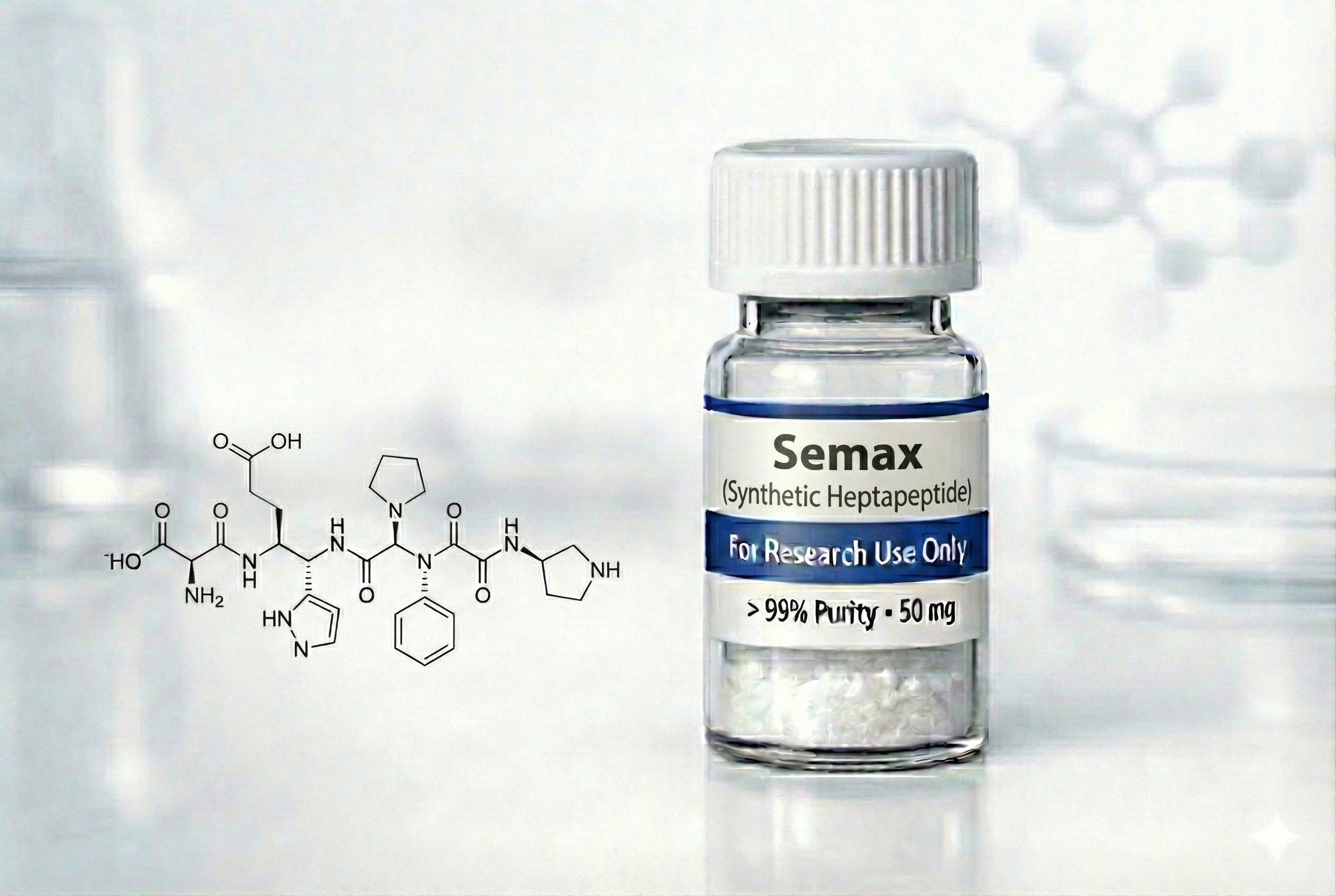
Semax

Semax – Synthetic neuroactive peptide that supports neuroprotection, cognitive function, and neurotrophin activity (BDNF, NGF). Clinically used in Russia for neurological conditions, but not FDA-approved in the US and intended for research use only.

$150.00

- +

Description

Semax is a synthetic heptapeptide consisting of seven amino acids: Methionine-Glutamic acid-Histidine-Phenylalanine-Proline-Glycine-Proline (Met-Glu-His-Phe-Pro-Gly-Pro). The peptide was developed by Russian researchers at the Institute of Molecular Genetics of the Russian Academy of Sciences in the 1980s based on the structure of adrenocorticotropic hormone (ACTH).

Structural Design and Stability:

Semax consists of two functional components:

ACTH(4-7) fragment (Met-Glu-His-Phe): The N-terminal portion derived from melanocortin peptide ACTH, which provides neurotrophic, behavioral, and cognitive effects without hormonal ACTH activity.

Pro-Gly-Pro (PGP) C-terminal tripeptide: Added to increase peptide stability and prolong biological effects. Natural ACTH fragments have extremely short half-lives (minutes), but the PGP modification extends Semax’s effects to 20-24 hours in animal models.

Molecular Characteristics:

Semax is classified among short regulatory peptides. The molecule demonstrates high affinity for copper(II) ions, suggesting potential metal-chelating properties that may contribute to neuroprotective effects.

Degradation and Active Metabolites:

Semax undergoes rapid enzymatic degradation in rat serum, producing a mixture of derivative peptides. Studies tracking Semax biodistribution after intranasal administration found that Pro-Gly-Pro (PGP) was the predominant metabolite in brain tissues 1 hour after injection. Research comparing Semax and PGP effects suggests some Semax actions are mediated by the PGP component formed during degradation, though Semax and PGP also exert distinct effects through separate mechanisms.

Routes of Administration:

Intranasal: Most common route in clinical practice; Semax crosses the blood-brain barrier after intranasal application. Studies confirm Semax entry into rat brain following intranasal administration, with PGP detected in brain tissue within 1 hour.

Intraperitoneal: Used in animal research studies.

Intravenous: Investigated in clinical trials; Semax enters rat brain following IV injection.

Subcutaneous: Alternative parenteral route.

Regulatory Status:

Russia and CIS Countries: Semax is a registered pharmaceutical drug available by prescription for conditions including:

  • Ischemic stroke (acute and recovery phases)
  • Cognitive disorders and dementia
  • Optic nerve atrophy
  • Encephalopathy
  • Transient ischemic attacks

Semax has been in clinical use in Russia since the 1990s.

United States: Semax is not FDA-approved as a drug or dietary supplement. It is sold only as a research chemical, typically labeled “not for human use” to comply with regulatory restrictions. The FDA has not evaluated Semax for safety or efficacy.

European Union: Not approved; research compound only.

How It Works

Neurotrophin Gene Activation

Semax’s neuroprotective effects are closely linked to rapid activation of neurotrophin gene expression—a mechanism first discovered in rat glial cell cultures and subsequently confirmed in vivo.

BDNF (Brain-Derived Neurotrophic Factor) Upregulation:

Multiple studies demonstrate Semax significantly increases BDNF expression:

In vitro: Rapid induction of Bdnf mRNA in rat glial cell cultures after Semax treatment.

In vivo (intact rats): Semax increases both BDNF protein and mRNA levels, as well as TrkB receptor levels, in rat hippocampus.

Cerebral ischemia model: In rats with permanent middle cerebral artery occlusion (pMCAO), Semax enhanced Bdnf mRNA transcription in the cortex 3 hours after occlusion. This early upregulation is critical because BDNF downregulation at 3 hours appears related to surgical stress and narcosis; Semax counteracts this decline.

Human stroke patients: Clinical study in 110 stroke patients showed Semax treatment (2 courses of 6000 µg/day for 10 days with 20-day interval) significantly increased plasma BDNF levels.

BDNF is described as a “key molecule involved in plastic changes related to learning and memory,” and BDNF depletion is associated with Alzheimer’s biomarkers, poor stroke recovery, and cognitive decline.

NGF (Nerve Growth Factor) Activation:

Semax treatment significantly enhanced Ngf mRNA expression in the ischemic rat cortex at 24 and 72 hours after occlusion. This activation pattern is critical because under ischemic conditions alone, Ngf transcription increases during the first day but completely recovers by 72 hours. Semax prolonged and enhanced this neuroprotective response.

Neurotrophin-3 (NT-3) Modulation:

Semax enhanced Nt-3 mRNA transcription 24 hours after cerebral ischemia and prevented the transcription decrease that normally occurs.

Neurotrophin Receptor Activation:

Critically, Semax not only upregulates neurotrophins but also their high-affinity Trk receptors:

TrkA: Enhanced 3 hours after ischemia
TrkB: Increased in hippocampus of intact rats; effects on TrkB expression
TrkC: Significantly upregulated 3 hours after ischemia

This coordinated upregulation of both neurotrophins and their receptors is essential for neuroprotection. Neurotrophins promote neuronal survival by binding to Trk receptors; without functional receptors, neurons cannot respond to neurotrophin signals despite their presence. Under ischemic conditions alone, neurotrophin upregulation is accompanied by receptor downregulation, giving cells “a slim chance of survival”. Semax corrects this imbalance by enhancing both components simultaneously.

Temporal Selectivity:

Semax demonstrates remarkable selectivity: it specifically activates neurotrophin transcription in ischemic cortex but shows minimal effects in intact rat brains or sham-operated animals. This tissue-specific and condition-specific activity suggests Semax targets pathological processes rather than normal physiology.

Massive Gene Expression Modulation

A 2014 genome-wide transcriptional analysis revealed the extraordinary scope of Semax’s molecular effects.

Scale of Gene Modulation:

Using the RatRef-12 Expression BeadChip containing 22,226 genes, researchers found Semax significantly altered expression of:

3 hours after ischemia: 96 genes (cut-off 1.50-fold change)

  • 52 genes with decreased expression
  • 44 genes with increased expression
  • Transcription regulator genes predominantly enhanced
  • Transmembrane receptor, transport protein, and enzyme genes predominantly decreased

24 hours after ischemia: 68 genes

  • 51 genes with increased expression
  • 17 genes with decreased expression
  • Immunoglobulin and chemokine genes showed largest increases

Importantly, different gene groups responded at different time points; only 10 genes showed altered expression at both time points, and their responses were often contradictory.

Immune System Gene Dominance:

The most striking finding was Semax’s profound effect on immune system genes:

At 24 hours: Immune-response genes represented over 50% of the total number of genes exhibiting altered expression.

Immunoglobulin genes: Formed the most prominent group, with half exhibiting the highest amplitude of expression alteration:

  • Similar to immunoglobulin heavy chain variable region: 15.37-fold increase (highest of all genes)
  • Multiple immunoglobulin kappa-chain genes: 2.8 to 11.57-fold increases
  • Serum IgG2a: 2.97-fold increase

Chemokine genes: Another remarkable group:

  • CXCL13: 4.12-fold increase
  • CXCL9: 2.42-fold increase
  • CXCL10, CXCL11, CCL5, CCL7, CCL19: 1.72 to 2.32-fold increases

MHC (Major Histocompatibility Complex) genes: Modulated at both time points, with shift from downregulation at 3 hours to upregulation at 24 hours.

Functional Significance:

These gene expression changes translated to profound effects on biological processes (Fisher’s exact test, p<0.01):

3 hours post-ischemia: Semax influenced genes affecting immune cell activity, particularly macrophages, neutrophils, and lymphocytes.

24 hours post-ischemia: Most significant effects on:

  • Leukocyte attraction (p-value = 7.6 × 10⁻⁸, most significant)
  • Dendritic cell migration and attraction
  • Calcium ion regulation (12 genes altered, including multiple chemokines)

Vascular System Gene Activation

Semax significantly influenced genes promoting formation and function of the vascular system in ischemic conditions. ​

3 Hours After Ischemia (24 genes altered):

Angiogenesis and vasculogenesis genes:

  • Cyr61 (cysteine-rich angiogenic inducer): 2.43-fold increase
  • ADAMTS1: 2.18-fold increase
  • Multiple transcription factors (ATF3, KLF4, Fos, JunB): 2.03-2.24-fold increases

Vascular function genes:

  • COX-2 (Ptgs2): 2.00-fold increase
  • BDNF: 1.88-fold increase (functions in both neurotrophin and vascular pathways)
  • ICAM1: 1.61-fold increase

Processes affected: Vasculogenesis, artery vasodilation, hematopoiesis, endothelial cell migration. Previous studies showed capillary bore extension as early as 15 minutes after Semax administration.

24 Hours After Ischemia (12 genes altered):

Later-stage vascular processes:

  • Endothelial tissue development
  • Smooth muscle cell migration (indicates vessel stabilization)
  • Blood cell activation (following logically after hematopoiesis initiation at 3 hours)

Key genes:

  • Multiple chemokines (CXCL9, CXCL10, CCL5, CCL7): 1.78-2.42-fold increases
  • MHC genes (RT1-Ba, RT1-A1, CD74): 1.63-2.28-fold increases
  • SPP1 (secreted phosphoprotein 1): 1.58-fold increase

Calcium Homeostasis Regulation

Semax significantly affected genes regulating intracellular Ca²⁺ levels—a critical mechanism in ischemic neuroprotection.

Gene Expression Changes (24 hours, 12 genes):

Highest increase: Transthyretin (Ttr): 20.55-fold increase
Chemokines with Ca²⁺ regulatory functions: CXCL13, CXCL9, CXCL10, CCL5, CXCL11, CCL7, CCL19 (1.72-4.12-fold increases)
Neuropeptides: TRH (thyrotropin releasing hormone): 1.95-fold increase; GRP (gastrin releasing peptide): 1.53-fold increase

Mechanistic Implications:

Ischemia-induced energy depletion disrupts calcium channels and Na⁺/Ca²⁺ pumps, causing excessive intracellular Ca²⁺ accumulation and neuronal death. However, Semax enhances neuron survivability under glutamate neurotoxicity that accompanies ischemia. The paradox—Semax increases expression of genes promoting Ca²⁺ accumulation yet protects neurons—suggests cellular death is caused by the Ca²⁺ influx pathway rather than Ca²⁺ load itself.

Evidence supports this hypothesis:

  • Neuroprotective effect of Ca²⁺-activated potassium channels in brain ischemic damage
  • Semax effects on human neutrophils show increased Ca²⁺ levels via regulation of Ca²⁺-dependent channels
  • Many chemokines raise intracellular Ca²⁺, which plays a messenger role in nervous tissues

Dopaminergic System Modulation

Semax augments the effects of psychostimulants on central dopamine release. This mechanism may contribute to Semax’s cognitive-enhancing effects and potential therapeutic application for attention-deficit/hyperactivity disorder (ADHD).

Anti-inflammatory and Antioxidant Effects

Nitric Oxide Synthesis Inhibition: Semax inhibits nitric oxide synthesis, reducing oxidative stress.

Mitochondrial Stability: Semax protects mitochondrial stability under calcium dysregulation stress.

Glutamate Neurotoxicity Protection: Semax increases survival of cerebellar granule cells under glutamate neurotoxicity conditions.

Research Evidence

Human Clinical Trials—Ischemic Stroke

Gusev EI, et al. Effectiveness of semax in acute period of hemispheric ischemic stroke. Zh Nevrol Psikhiatr Im S S Korsakova. 1997;97(6):26-34.

Design: Controlled study comparing Semax plus standard therapy vs. standard therapy alone.

Treatment Groups:

  • Semax group (N=30): Conventional therapy + Semax
    • Moderate severity strokes: 12 mg/day for 5 days
    • Severe strokes: 18 mg/day for 10 days
  • Control group (N=80): Conventional therapy only (strokes matched for severity and location)

Assessment Methods:

  • Clinical rating scales for severity and neurological defect
  • EEG with mapping
  • Somatosensory evoked potentials with mapping

Results:

  • Faster restoration of damaged neurological functions in Semax group
  • Increased regression of:
    • General cerebral symptoms
    • Focal neurological disorders (especially motor deficits)
  • Most effective daily doses established: 12 mg for moderate strokes, 18 mg for severe strokes

Significance: Demonstrated Semax accelerates neurological recovery when added to standard ischemic stroke therapy; established dose-response relationship based on stroke severity.

Study 2: Early Rehabilitation and BDNF (N=110)

Ashmarin IP, et al. The efficacy of semax in the treatment of patients at different stages of ischemic stroke. Zh Nevrol Psikhiatr Im S S Korsakova. 2017;117(4 Pt 2):61-68.

Design: Study examining Semax effects at different stroke stages.

Treatment: 2 courses of Semax (6000 µg/day for 10 days with 20-day interval between courses).

Results:

  • Increased plasma BDNF levels
  • Accelerated functional recovery
  • Improved motor performance

Quote: “Early rehabilitation and administration of semax increase BDNF plasma level, speed functional recovery, and improve motor performance”.

Significance: First human study demonstrating Semax’s mechanism involves BDNF elevation, bridging animal research findings to clinical outcomes.

Study 3: Stroke Prevention (Date unspecified)

Design: Study examining Semax for preventing disease progression in stroke-prone patients.

Results:

  • Significant clinical improvement
  • Stabilization of disease progress
  • Reduced risk of stroke
  • Reduced risk of transitory ischemic attacks

Animal Studies—Focal Cerebral Ischemia

Genome-Wide Transcriptional Analysis (Medvedeva et al., 2014)

Medvedeva EV, Dmitrieva VG, Povarova OV, et al. The peptide semax affects the expression of genes related to the immune and vascular systems in rat brain focal ischemia: genome-wide transcriptional analysis. BMC Genomics. 2014;15:228.

Design: Genome-wide gene expression study using RatRef-12 Expression BeadChip (22,226 genes) in rats with permanent middle cerebral artery occlusion (pMCAO).

Treatment: Semax 100 μg/kg intraperitoneally at 15 min, 1, 4, and 8 hours after pMCAO.

Time Points: 3 hours and 24 hours after occlusion.

Study Population: Adult male Wistar rats (270-320g) divided into “ischemia” and “ischemia + Semax” groups.

Results:

Gene Expression Scale:

  • 3 hours: 96 genes altered (cut-off 1.50-fold)
  • 24 hours: 68 genes altered
  • Only 10 genes overlapped between time points

Functional Categories (24 hours):

  • Immune system genes: >50% of all altered genes (most prominent finding)
  • Immunoglobulins: Up to 15.37-fold increases (highest of any genes)
  • Chemokines: 1.72 to 4.12-fold increases
  • Vascular system genes: 24 genes at 3h, 12 genes at 24h
  • Ca²⁺ regulatory genes: 12 genes significantly altered

Biological Processes Most Affected (Fisher’s exact test):

  • Leukocyte attraction: p = 7.6 × 10⁻⁸ (most significant)
  • Dendritic cell migration
  • Calcium ion regulation
  • Vasculogenesis and hematopoiesis (3h)
  • Endothelial tissue development (24h)

Significance: First study to reveal Semax’s immunomodulatory mechanism; challenges previous assumption that neuroprotection was solely nervous-tissue-specific. Authors conclude: “The immunomodulating effect of the peptide discovered in our research and its impact on the vascular system during ischemia are likely to be the key mechanisms underlying the neuroprotective effects of the peptide”.

Neurotrophin Activation Study (Dmitrieva et al., 2010)

Dmitrieva VG, Povarova OV, Skvortsova VI, et al. Semax and Pro-Gly-Pro Activate the Transcription of Neurotrophins and Their Receptor Genes after Cerebral Ischemia. Cell Mol Neurobiol. 2010;30(1):71-79.

Design: Study investigating neurotrophin mRNA expression after pMCAO with Semax or PGP treatment.

Treatment: Rats received either Semax (100 μg/kg) or PGP (37.5 μg/kg) intraperitoneally at specified intervals.

Time Points: 3, 24, and 72 hours after occlusion.

Assessment: RT-PCR and real-time PCR quantitation of BdnfNt-3NgfTrkBTrkC, and TrkA mRNA levels.

Results:

Semax enhanced transcription of:

  • BdnfTrkCTrkA: 3 hours after occlusion
  • Nt-3Ngf: 24 hours after occlusion
  • Ngf: 72 hours after occlusion (sustained effect)

Tissue Selectivity:

  • Semax selectively affected transcription only in ischemic rat cortex
  • Minimal effects in rats without surgery or sham-operated rats
  • PGP showed mainly nonspecific influence across all conditions

Temporal Significance:
The activating influence was predominantly observed at 3 and 24 hours—the critical period when cells in the penumbra retain functional activity and can survive.

Quote: “Semax contributes to the survival of ischemic cells by enhancing the transcription not only of neurotrophins, but also of their high-affinity receptors… the success of urgent Semax therapy for stroke is mostly accounted for by the early upregulation of the transcription neurotrophins and their receptors”.

Significance: Demonstrated Semax’s tissue-specific and condition-specific neurotrophin activation; established coordinated upregulation of neurotrophins AND receptors as key neuroprotective mechanism.

Human Studies—Healthy Individuals

Pilot Studies (Limited Data)

Two pilot studies in healthy individuals examined Semax effects (specific methodological details and results not fully published in English literature).

Reported Effects:

  • Stimulates memory and attention after intranasal application
  • Nootropic-like activity in humans

Some users report cognitive enhancement benefits within 30 minutes

Current Status

Regulatory Divide: Russia vs. Western Countries

Approved Pharmaceutical (Russia and CIS):

Semax has been a registered pharmaceutical drug in Russia since the 1990s, available by prescription for:

  • Ischemic brain stroke (acute and recovery)
  • Encephalopathy
  • Optic nerve atrophy
  • Cognitive disorders and dementia
  • Prevention of stroke progression

Unauthorized Research Chemical (United States):

“Semax is not approved by the FDA as a drug or dietary supplement. It is sold only as a research chemical, typically labeled ‘not for human use’ to comply with regulatory restrictions”.

“Cognitive enhancement peptides like Semax and Selank are not FDA-approved for treating any medical condition in the United States. This means they have not gone through the large-scale, multi-phase clinical trials that the FDA requires to prove that a substance is both safe and effective for widespread public use”.

Evidence Quality Assessment

Strengths:

Extensive Russian clinical experience:

  • Decades of clinical use since 1990s
  • Multiple controlled trials in stroke patients
  • Established dosing protocols (12-18 mg/day based on severity)
  • Consistent findings across studies (accelerated recovery, improved motor function)

Strong mechanistic understanding:

  • Genome-wide transcriptional analysis identified 1,500+ genes affected
  • Neurotrophin activation confirmed at molecular level
  • Multiple converging mechanisms (neurotrophic, immunomodulatory, vascular)
  • Dose-response and temporal dynamics well-characterized in animal models

Human BDNF elevation:

  • Bridge between animal mechanisms and human outcomes established​

Limitations:

Geographic concentration of research:

  • Vast majority of clinical data from Russian/CIS countries
  • Limited replication in Western populations
  • Some key studies published only in Russian journals
  • Potential publication bias (positive studies more likely published)

Methodological concerns:

  • Older studies (1990s-2000s) may not meet current Phase III trial standards
  • Control group design not always optimal (80 controls vs. 30 treatment in Gusev study)
  • Some pilot study details not fully published
  • Lack of large-scale double-blind randomized controlled trials meeting FDA standards

Limited Western validation:

  • No FDA-sponsored clinical trials
  • Minimal published research from US/European institutions
  • Alzheimer’s Drug Discovery Foundation notes: “Published literature of well-conducted studies is lacking”

Safety Profile

Clinical Safety Data:

Russian clinical experience (30+ years):

  • “Semax has an excellent safety profile in both clinical trials and widespread clinical use”
  • No serious adverse events reported in published stroke trials
  • Well-tolerated at therapeutic doses (12-18 mg/day)

Adverse Effects:

The peptide’s “excellent tolerability and lack of significant adverse effects make it suitable for both acute interventions and long-term cognitive optimization”.

Published literature does not report significant safety concerns at therapeutic doses, though systematic Western safety evaluation is lacking.

Theoretical Concerns:

Immunomodulation: Semax’s profound effects on immune system genes (>50% of altered gene expression) raises questions about effects in immunocompromised individuals or those with autoimmune conditions.

Chemokine activation: Upregulation of chemokines could theoretically affect inflammatory conditions, though effects appear neuroprotective in ischemia context.

Calcium regulation: While protective in ischemia, effects on Ca²⁺ homeostasis in healthy individuals require further study.

Clinical Applications

Established Indications (Russia):

Ischemic stroke: Primary indication; accelerates recovery when initiated in acute phase
Cognitive disorders: Memory and attention deficits
Optic nerve diseases: Optic nerve atrophy and related conditions
Encephalopathy: Various causes
Stroke prevention: Reduces progression risk in at-risk patients

Investigational Applications:

Cognitive enhancement (nootropic): Memory, attention, learning capacity
ADHD: Potential therapeutic agent based on dopaminergic modulation
Alzheimer’s disease: BDNF elevation suggests potential benefit
Traumatic brain injury: Neuroprotective mechanisms applicable
Parkinson’s disease: Under investigation for neuroprotection

Dosing (From Russian Clinical Practice)

Stroke Treatment:

  • Moderate severity: 12 mg/day for 5 days
  • Severe stroke: 18 mg/day for 10 days
  • Extended protocol: 6000 µg/day for 10 days, repeated after 20-day interval

Route: Intranasal most common; intravenous in acute settings

Timing: Most effective when initiated early (within hours of stroke onset)

Research Gaps and Future Directions

Critical Studies Needed:

Phase III RCTs in Western populations:

  • Large-scale double-blind placebo-controlled trials
  • Stroke recovery endpoints meeting FDA approval standards
  • Long-term follow-up (6-12 months post-stroke)
  • Safety monitoring with systematic adverse event reporting

Cognitive enhancement trials:

  • Healthy population studies with objective cognitive testing
  • Dose-response curves for nootropic effects
  • Long-term safety of chronic use
  • Comparison to established cognitive enhancers

Mechanism studies:

  • Human gene expression studies (similar to rat genome-wide analysis)
  • Time-course of BDNF elevation in humans
  • Optimal timing relative to ischemic injury
  • Biomarkers predicting response

Safety characterization:

  • Systematic pharmacokinetics and pharmacodynamics
  • Drug-drug interaction studies
  • Effects in special populations (elderly, immunocompromised)
  • Long-term safety (>1 year continuous use)

Optimal delivery:

  • Intranasal vs. IV comparative effectiveness
  • Bioavailability optimization
  • Depot formulations for sustained release

Comparison to Other Neuroprotective Agents

  1. Citicoline:
  • Citicoline: FDA-approved in some countries; better Western validation
  • Semax: Stronger preclinical mechanistic data; more extensive gene modulation
  1. Cerebrolysin:
  • Cerebrolysin: Peptide mixture from porcine brain; approved in multiple countries
  • Semax: Synthetic single peptide; more defined mechanism; comparable neuroprotection
  1. Noopept:
  • Noopept: Another Russian nootropic peptide; shorter peptide (dipeptide)
  • Semax: Longer clinical track record; more robust stroke data
  1. Standard Stroke Therapies (tPA):
  • tPA: FDA-approved for acute stroke; narrow therapeutic window (3-4.5 hours)

Semax: Effective in broader window; complementary mechanism (neuroprotection vs. clot lysis)

Footnotes & References

  1. Dmitrieva VG, Povarova OV, Skvortsova VI, et al. Semax and Pro-Gly-Pro Activate the Transcription of Neurotrophins and Their Receptor Genes after Cerebral Ischemia. Cell Mol Neurobiol. 2010;30(1):71-79. PMID: 19633950.
  2. Medvedeva EV, Dmitrieva VG, Povarova OV, et al. The peptide semax affects the expression of genes related to the immune and vascular systems in rat brain focal ischemia: genome-wide transcriptional analysis. BMC Genomics. 2014;15:228. PMID: 24661604.

References

Clinical Trials

Gusev EI, et al. Effectiveness of semax in acute period of hemispheric ischemic stroke. Zh Nevrol Psikhiatr Im S S Korsakova. 1997;97(6):26-34.

Ashmarin IP, et al. The efficacy of semax in the treatment of patients at different stages of ischemic stroke. Zh Nevrol Psikhiatr Im S S Korsakova. 2017;117(4 Pt 2):61-68.

Key Research Studies

Medvedeva EV, Dmitrieva VG, Povarova OV, et al. The peptide semax affects the expression of genes related to the immune and vascular systems in rat brain focal ischemia: genome-wide transcriptional analysis. BMC Genomics. 2014;15:228.

Dmitrieva VG, Povarova OV, Skvortsova VI, et al. Semax and Pro-Gly-Pro Activate the Transcription of Neurotrophins and Their Receptor Genes after Cerebral Ischemia. Cell Mol Neurobiol. 2010;30(1):71-79.

Regulatory and Clinical Use

Swolverine. Semax Dosing Guide: Protocols, Benefits, and Side Effects.

Philly Wellness Center. Cognitive enhancement peptides: a beginner’s guide to safety.

Semax Peptide | Benefits, Safety & Buying Advice

Disclaimer

This content is for educational and research purposes only.

Semax is not FDA-approved in the United States and is available only as a research chemical labeled “not for human use.”

While extensively used clinically in Russia and CIS countries for over 30 years with reported excellent safety, Semax has not undergone FDA-required Phase III clinical trials.

The majority of human clinical evidence originates from Russian sources, with limited Western replication.

The 2014 discovery that Semax modulates over 1,500 genes—with immune system genes representing >50% of altered gene expression—represents a paradigm shift in understanding its mechanisms but also highlights the complexity of its biological effects.

Potential users should be aware that Western regulatory agencies have not evaluated Semax for safety or efficacy. This peptide should be considered investigational outside Russia, with use carrying unknown risks in populations not studied in published trials.

Reviews

There are no reviews yet.

Be the first to review “Semax”

Your email address will not be published. Required fields are marked *

Latest News

Latest Research Updates

Curated news and publications on peptides, metabolic research, and cellular energy modulation.
SemaxSemax